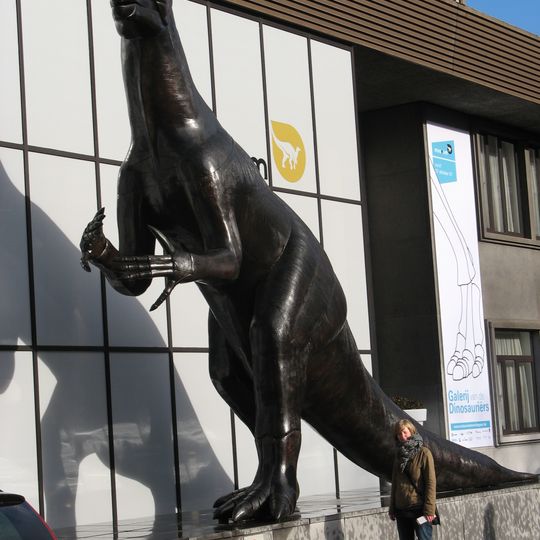
Museum of Natural Sciences of Belgium, Natural history museum in Leopold Park, Brussels, Belgium
The Museum of Natural Sciences is a major institution housing extensive collections on Earth's history and biology in Brussels. The exhibitions spread across multiple levels and focus on evolution, fossils, minerals, and life forms spanning different geological periods.
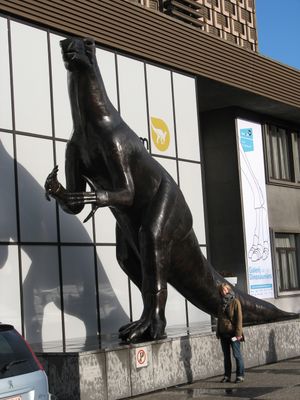
The collections were assembled at the end of the 18th century by Prince Charles Alexander of Lorraine and grew out of the Brussels Museum founded in 1802. A royal decree of 31 March 1846 created the Royal Museum of Natural History, with Bernard du Bus de Gisignies as first director. In 1878, 38 Iguanodon skeletons were found at Bernissart, 30 of which were mounted by Louis Dollo. The museum moved to Leopold Park in 1891, and its south wing, designed by Charles-Émile Janlet, was completed in 1905.
The museum's name changed on 24 September 1948, after 102 years, to the Royal Belgian Institute of Natural Sciences, stressing its research role. Its collections number about 38 million specimens, including over 20 million insects. The Dinosaur Hall reopened on 27 October 2007, and in 2022 a mural by Spanish artist Rocío Álvarez on the surrounding walls marked Greenpeace's 50th anniversary.
The museum sits near metro stations Maelbeek and Schuman, making it easy to reach by public transport. Guided tours in multiple languages are available, and on-site cafés offer refreshment during your visit.
The museum holds thirty complete Iguanodon skeletons discovered in 1878 at a coal mine, the world's largest collection of these fossils. This extraordinary find established Belgium as a center of dinosaur research and remains the museum's crown jewel.
The community of curious travelers
AroundUs brings together thousands of curated places, local tips, and hidden gems, enriched daily by 93,451 contributors worldwide.