Castle of Vêves, Medieval castle in Houyet, Belgium.
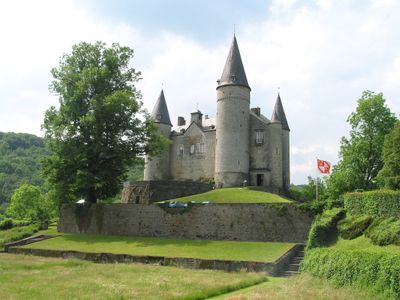
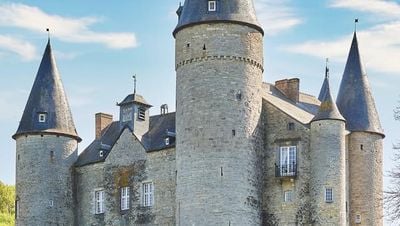
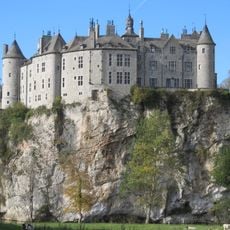
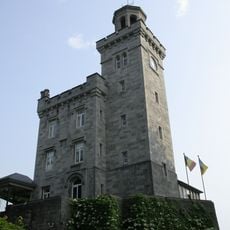
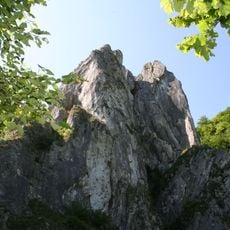
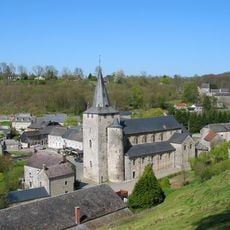
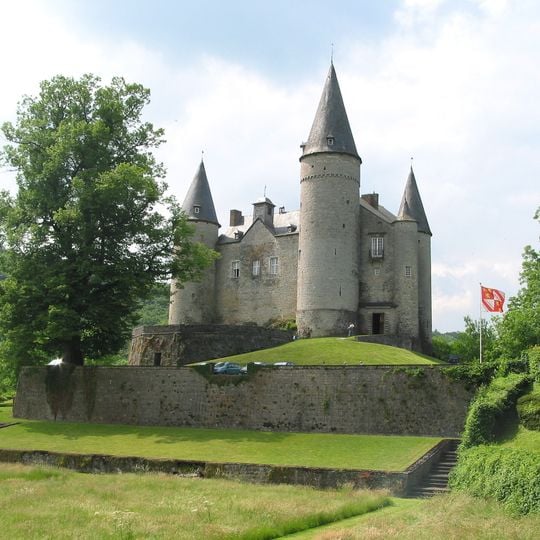
Castle of Vêves is a fortress with six circular towers topped by pointed roofs arranged atop a rocky elevation near Dinant. The building combines multiple construction phases, with medieval sections meeting structures added later.
Pippin of Herstal built a villa here in the second half of the 7th century, near Saint Hadelin's hermitage at Celles; his successors turned it into a small fortress in the 9th century. That fortress was razed in 1200 and rebuilt in 1220 by the Beaufort family, who acquired the lordship through Walter of Beaufort's marriage to Ode of Brittany. The castle burned in 1200 and was rebuilt by 1230, then was destroyed by the Dinantais in 1410 and restored at once. In 1793 French revolutionaries damaged it, and the Liedekerke-Beaufort family restored it in the 18th century, giving it its present appearance.
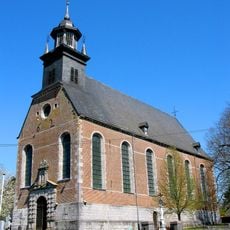
The castle chapel once held a terracotta Virgin Mary found by a woodcutter in an oak; it drew pilgrims, so the lords moved it to the Église Notre-Dame de Foy, built on the oak's spot. Inside, the restored armoury hall keeps its fireplace, ceiling and sandstone floor with a mosaic of coats of arms.
The castle stands on a grassy hill above Celles, reached by a climb from the village; the irregular plan follows the rock, so floors and courtyards sit at different levels. The interior is opened to the public only part of the year, following the restoration campaign of 1969-1979. Allow time to walk the enclosed courtyard and the rooms at your own pace.
Wooden galleries on two levels in the inner courtyard connect the medieval area to a 16th-century wing, a feature that makes the building's history visible in its layout. These wooden structures show how different time periods were physically linked together.
The community of curious travelers
AroundUs brings together thousands of curated places, local tips, and hidden gems, enriched daily by 93,400 contributors worldwide.