Poilvache Castle, Medieval castle ruins on limestone cliffs in Yvoir, Belgium
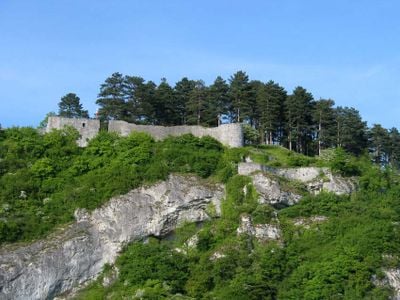
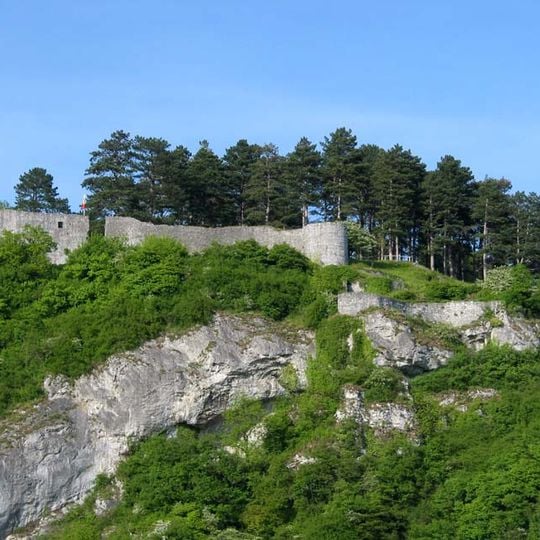
Poilvache Castle is a ruined medieval fortress on a grey rock spur above the Meuse, near Houx in the Walloon municipality of Yvoir. A straight low wall of pale grey stone stands on the left; in the centre a darker shaded section lies behind a projecting curved bastion of lighter stone, and on the right a lower wall links to another projecting structure. The weathered masonry of irregular blocks has no roof, and vegetation grows around the walls.
Poilvache grew from a 12th-century conflict between Namur and Luxembourg over a succession, becoming a fortified town and castle guarding the County of Luxembourg. Ermesinde I of Luxembourg acquired it in 1199 and gave it to her daughter Isabella of Bar, who strengthened it. In 1430 the prince-bishop of Liège, John VIII of Heinsberg, besieged it with some 30,000 men and had it dismantled; French troops of Henry II destroyed the remains in 1554.
The fortress shaped regional trade through its own mint, which produced coins that showed its economic reach. Visitors today can still sense this former importance when walking through the ruins.
Visitors reach the ruins via a walking trail of about 3 kilometers from Houx village, marked with red and blue signs along the limestone hillside. The path climbs gradually, so wear sturdy shoes, especially in wet conditions.
The name Poilvache ("cow-hide") comes from a ruse attributed to the men of Dinant: disguised in prisoners' clothes and cattle hides and mingling with a herd, they slipped into the stronghold. The site was first recorded in 1228 as chastiau d'émeraude, the emerald castle, later shortened to Méraude.
The community of curious travelers
AroundUs brings together thousands of curated places, local tips, and hidden gems, enriched daily by 93,625 contributors worldwide.