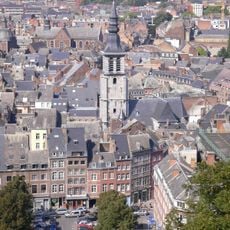
Belfry of Namur, Medieval bell tower in Namur, Belgium.
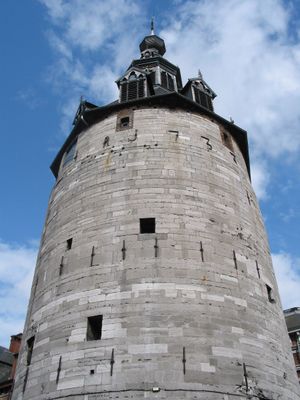
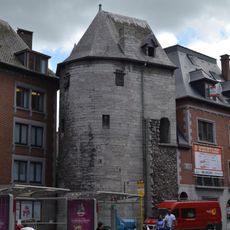
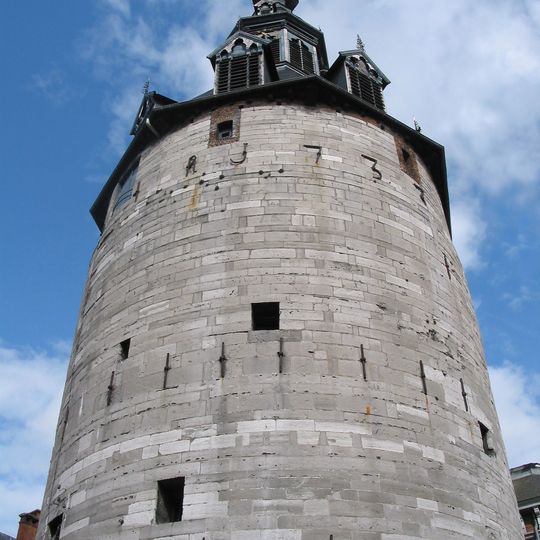
The Belfry of Namur, also called Tour Saint-Jacques, is a tall cylindrical tower of stacked light grey ashlar blocks, one of the three towers of the medieval city wall. Its upper stone face carries dark metal numerals and letters set in an arc, reading "R J 5 7 3 7", above small rectangular openings and vertical iron tie bars. A dark slate roof with a central square lantern and four corner turrets with pointed finials caps the tower, and a larger rectangular window opening sits near the base.
Built around 1388 as one of three towers in Namur's medieval wall, the Tour Saint-Jacques guarded a city gate; from 1570 its bancloque signalled the opening and closing of the outer gates. After the Saint-Pierre-au-Château church burned in the 1745 siege, the tower became the city belfry in 1746, and the wall was later demolished while the tower was kept and restored.
The tower's name Saint-Jacques comes from the city gate it guarded in the medieval wall. From 1570 its bancloque bell signaled the opening and closing of Namur's outer gates. Since 1746 it has housed the civic bell that marked time and events for the city, a role now recognized by its UNESCO listing among the belfries of Belgium and France.
The tower stands on Rue du Beffroi, a short walk uphill from Namur's central squares; the exterior, including the iron numerals "R J 5 7 3 7" and the impact marks of 18 August 1944, is visible at any hour from the street. Interior access is not open on a casual basis, so ask at the local tourist office before planning a climb.
The tower was originally almost twice as tall as it is today. Its bancloque, in place from 1570, signalled the opening and closing of the outer city gates. The American bombardment of 18 August 1944 struck the belfry; a nun was thrown against the building and killed, and impact marks remain visible on the stone.
The community of curious travelers
AroundUs brings together thousands of curated places, local tips, and hidden gems, enriched daily by 94,056 contributors worldwide.