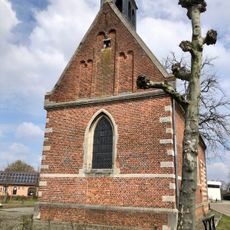
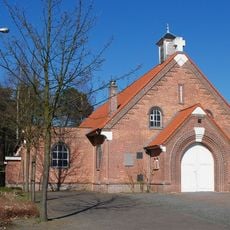
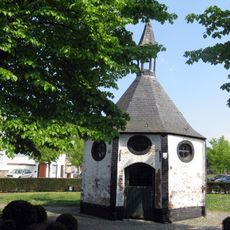
Sint-Quintinuskerk, Church building in Zonhoven, Belgium.
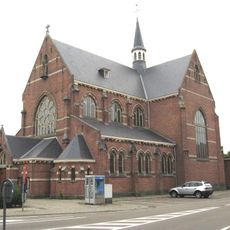
Sint-Quintinuskerk is a brick church in Zonhoven with a classicist nave built in 1785–1788 and a separate early Gothic west tower from the late 13th or early 14th century, linked to the nave by a narrow section. The nave has three aisles of seven bays, a choir with a nearly semi-circular apse, and a facade with a round-arched niche holding a gilded statue of Saint Quintinus above the coat of arms of abbess Augustina van Hamme.
The parish became independent in the 12th century under Saint Quintinus, the same patron as Hasselt, and remained under Herkenrode Abbey, whose abbess nominated pastors and shared tithe income with them. The early Gothic tower, built around 1300 with walls 1.6 metres thick, served as a refuge during sieges. The present classicist church was built in 1785–1788 after the old church was demolished; its foundations rest on 700 oak trunks from Bokrijk, and the first Sunday Mass was celebrated at Christmas 1788.
The parish's patron is Saint Quintinus, the same patron as Hasselt, and the church keeps a statue of Anne with the Virgin and Child plus a holy water font from the earlier Gothic church. The fourteen Stations of the Cross, painted by Aloïs De Beule in 1904, hang on the side walls, each paired with a medallion of an apostle; the choir medallions show the four evangelists.
The church holds regular religious services throughout the year, including masses, baptisms, and other ceremonies that visitors can observe. Checking local information beforehand helps you plan your visit around these events and understand what to expect when you arrive.
The organ's oldest section was built in 1664 by Pascal Limbourg, who reused material from the organ of the Janskerk in Utrecht. Between 1761 and 1763 Robustelly rebuilt the instrument completely. Look for the organ above the west end, facing the nave.
The community of curious travelers
AroundUs brings together thousands of curated places, local tips, and hidden gems, enriched daily by 94,023 contributors worldwide.