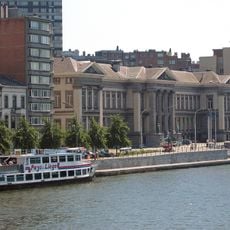
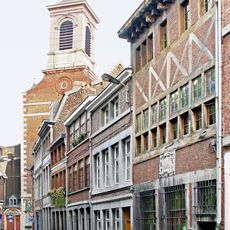
Outremeuse, Working-class neighborhood in Liège, Belgium.
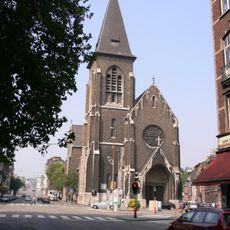
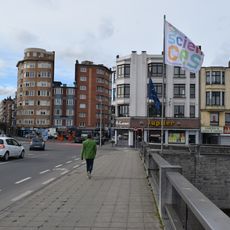
Outremeuse is a neighborhood on an island between the Meuse and the Dérivation, formed when the river arms were filled in the 19th century. Its main axis, the chaussée d'Aix-la-Chapelle, follows the old road from the pont des Arches through Puits-en-Sock and Entre-Deux-Ponts. The Saint-Pholien church, rebuilt in the 18th century, stands at a street junction; its rough grey stone body has a steep slate roof, two tall arched windows and a lower round-arched window at the base.
Outremeuse was a marsh between the Ourthe and the Meuse, attached to Liège in the 11th century when Prince-Bishop Réginard built the road to Aachen. A first wall followed in the 13th century, a second in 1537 under Paul de Richelle, with a balloir and walls 3.6 m thick. The Meuse arms were filled in the 19th century, creating the boulevards and the island.
The neighborhood celebrates an annual festival on August 15th with brass bands, street performances, and puppet shows featuring the character Tchantchès. These traditions remain deeply rooted in daily life and attract both residents and visitors each year.
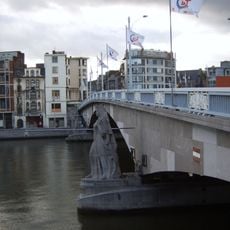
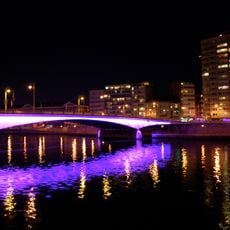
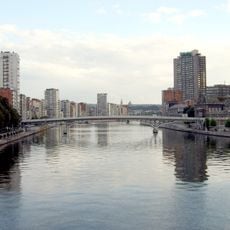
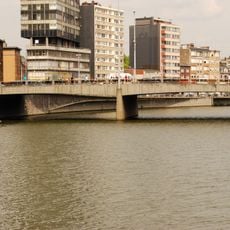
Outremeuse lies on the right bank of the Meuse, reached from the historic centre by the Pont des Arches, and since the 19th-century digging of the Dérivation canal it forms an island together with Longdoz. The grid of streets between the river and the canal is compact and flat, so the district is covered on foot; bridges also link it to the Amercœur district and to Bressoux.
The neighborhood preserves several Art Nouveau buildings with decorative facades, curved iron railings, and colored glass windows tucked among the brick structures. These details reveal a time when even working-class areas were touched by artistic ambition.
The community of curious travelers
AroundUs brings together thousands of curated places, local tips, and hidden gems, enriched daily by 93,586 contributors worldwide.