Rommelaere Instituut, University medical institute in Ghent, Belgium
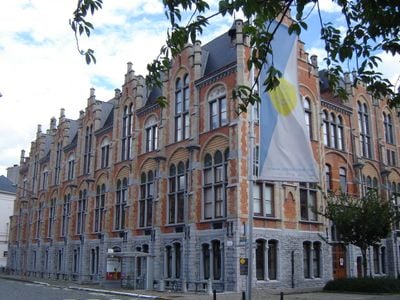
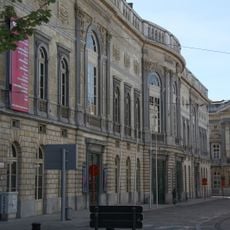
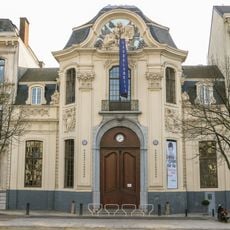
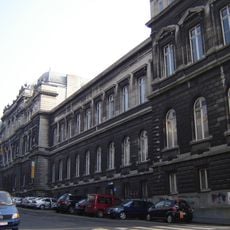
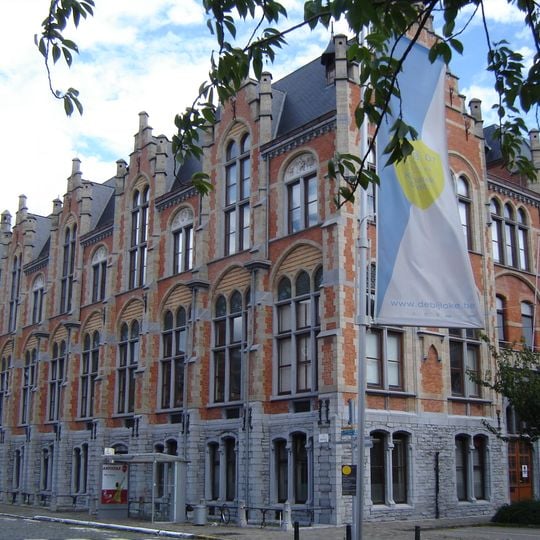
The Rommelaere Institute is a U-shaped neo-Gothic complex completed in 1899 by architect Louis Cloquet, mixing Brabant and Flemish styles. Its brick facades with grey stone bases and steep slate roofs are divided into bays by stone columns; tall arched windows sit above flat-topped ones, and the ground floor is clad in rough grey stone with small arched openings. A banner reading "www.debijloke.be" hangs near the right edge.
Construction took place from 1899 to 1905 under architect Louis Cloquet's design. The project was funded by Arthur Renier to commemorate Doctor Willem Rommelaere's medical career.
The institute is named after Guillaume "Willem" Rommelaere, a Ghent-born physician who served as personal doctor to Queen Marie Henriette and rector of the Université libre de Bruxelles. A West Flemish businessman, Arthur Renier, paid part of the construction cost out of gratitude for Rommelaere's treatment. Rommelaere entered the building only once, at its inauguration.
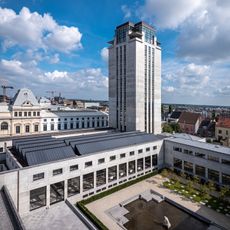
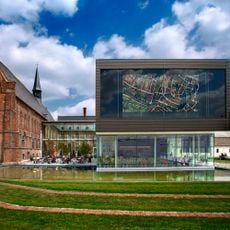
The U-shaped complex is bounded by Hospitaalstraat on the west, Apotheekstraat on the north and Prof. Jozef Kluyskensstraat on the south, with a courtyard pavilion and a meteorological tower inside. The university sold it in 2025 and a school, childcare, offices, workshops and a restaurant are planned after restoration, so access may be limited during works.
The site's earlier laboratory is where microbiologist Émile Van Ermengem identified the bacterium Clostridium botulinum in 1895, explaining the cause of botulism. The new building went into use in 1905. Willem Rommelaere, whom it honours, is said to have entered it only once, at the inauguration.
The community of curious travelers
AroundUs brings together thousands of curated places, local tips, and hidden gems, enriched daily by 94,055 contributors worldwide.