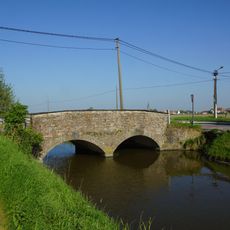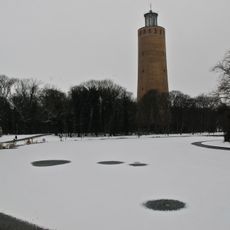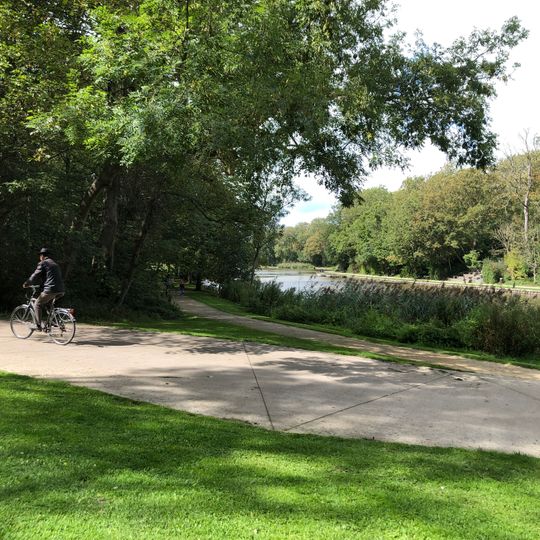
Maria Hendrikapark, Protected monument park in Ostend, Belgium.
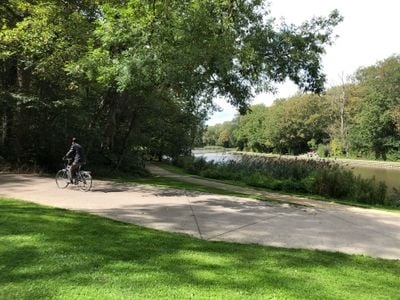
Maria Hendrikapark covers 27 hectares south of the old town walls, laid out from 1886 by German landscape architect Édouard Keilig on the site of a wild wood. A broad path of large light-grey concrete slabs, seamed by dark expansion joints, runs between mown grass and the water, curving out of sight between trees. The park doubled in size in 1896 with the Spiegelmeer and Konijnenvijver.
The park was created in 1892 when King Leopold II commissioned German landscape architect Eduard Keilig to design it. This project represented an effort to develop the area into a modern recreational space for the city.
Ostend locals call the park 't Bosje, and the café-restaurant on the pond island, the Koninginnehof, is still nicknamed 't Laiterietje after the Laiterie Royale built there in the 1890s. The Armenonville, a second drinking establishment tied to a shooting club, also survives. The park's own day is marked on the last Sunday of May or first Sunday of June.
The main path is a broad, flat route of large concrete slabs with thin expansion joints, bordered by mown grass on one side and a narrow verge before the water on the other; it narrows and curves between the trees and the bank. The Nelson Mandelabrug, a suspension bridge built during the 2003-2006 renovation, carries cyclists and pedestrians over the large pond. Rowboats can be hired at the Koninginnehof on the island in the Koninginnevijver.
The park's suspension bridge over the large pond was renamed Nelson Mandelabrug in early 2014, after the South African statesman who died on 5 December 2013. It carries cyclists and pedestrians, and two contemporary works stand in the grounds: "Three Graces" by Michael Ray Charles and "Zon-Anima-Animus" by Johan Tahon.
The community of curious travelers
AroundUs brings together thousands of curated places, local tips, and hidden gems, enriched daily by 93,457 contributors worldwide.