De Smet de Naeyerbruggen, Railway bridge complex in Ostend, Belgium.
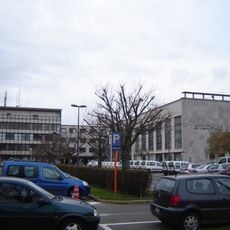
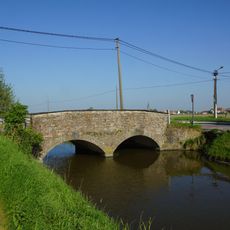
De Smet de Naeyerbruggen is a bridge complex about 300 metres south of Ostend station, built 1903–1905 to designs by Alban Chambon. Its first part is a fixed bascule bridge over the railway tracks, a fixed span over a former drainage canal to Bruges, and a crossing of the Slachthuiskaai; the second part is a swing bridge at the Demey sea lock spanning the Vlotdok. The fixed bascule section was closed to traffic in 2002 and now serves as a parking area.
The bridge complex was built between 1903 and 1905 on the initiative of Leopold II, to plans by Alban Chambon, architect of Ostend's theatre and Kursaal. It completed the expansion of Ostend's harbour and opened a coastal road link from De Panne to Knokke. It was inaugurated in 1905 in the presence of the king and Count Paul de Smet de Naeyer, then minister of Finance and Public Works, after whom it is named.
Locals call the complex "Tettenbrug" (breast bridge) after the large bronze angels with bare breasts by sculptor Julien Dillens (1849-1904) that decorated the high piers before World War I. The nickname survives even though the statues were removed during the German occupation and melted down for weapons.
The parking section is easily reached and provides a practical spot for visitors needing to park near the harbor area. The Demey sea lock and the railway line serve as clear reference points to locate this complex within the coastal zone.
German forces occupying the city during World War I removed the bronze sculptures and lion ornaments to melt them down for military equipment production. Few visitors today realize that much of the artistic detail once graced this crossing but was lost to wartime metal collection efforts.
The community of curious travelers
AroundUs brings together thousands of curated places, local tips, and hidden gems, enriched daily by 93,920 contributors worldwide.