Cornillon Abbey, Medieval monastery in Liège, Belgium
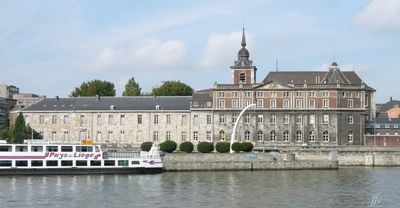
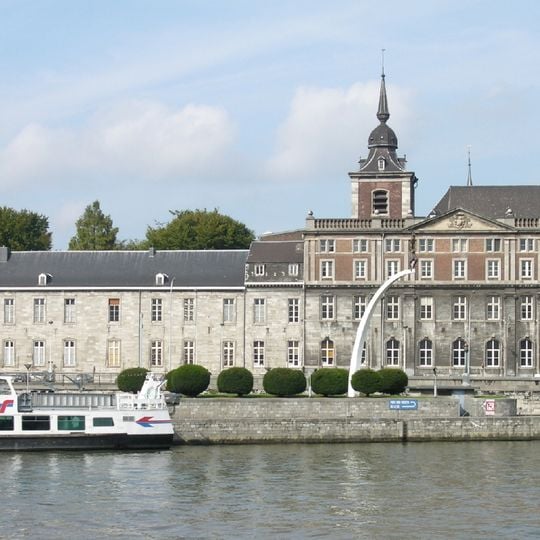
Beaurepart Abbey stands in Liège beside the Meuse, on an island formed by two river arms that were later filled in. The long stone building has two light grey storeys with rows of rectangular windows, some with pale blue shutters, and a darker brown brick upper storey topped by a slate roof and a tall dark spire with a small lantern and cross. A slender white arch curves up in front of the facade, and a paved terrace with clipped green shrubs runs along the base.
Beaurepart was built in the early 13th century for the Friars Minor on an island between two arms of the Meuse, later filled in. After a fire in 1234 the friars returned in 1235, a bellus reditus that gave the house its name; they left for Richefontaine in 1243. In 1288 the Premonstratensians of Cornillon, whose abbey was being ravaged, took over the site and stayed until the abbey was suppressed in 1796.
The name Beaurepart comes from the Latin bellus reditus, "beautiful return": the Friars Minor rebuilt their burnt convent and moved back in 1235. In Walloon the site was called å bairpâ. The Premonstratensians of Cornillon, installed in 1288, held the right to appoint priests in nine parishes, including Jupille, Soumagne and Rekem.
The former abbey has housed the Grand Seminary of Liège and the bishop's palace since 1809, so the buildings are in active ecclesiastical use. The site lies on the right bank of the Meuse, on the filled arm near boulevard Piercot, and the 18th-century cloister and churches are best seen from the paved terrace along the river.
The abbey's name comes from a fire: after the Franciscans' convent burned in 1234, it was rebuilt and they returned in 1235, a return called bellus reditus, or beau-repart in French. The Walloon form å bairpâ preserves this origin. The name later passed to the Premonstratensians who took over the site in 1288.
The community of curious travelers
AroundUs brings together thousands of curated places, local tips, and hidden gems, enriched daily by 93,458 contributors worldwide.