Duden Park, Protected heritage park in Forest, Belgium
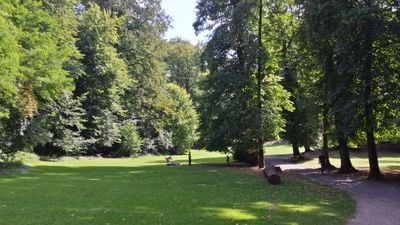
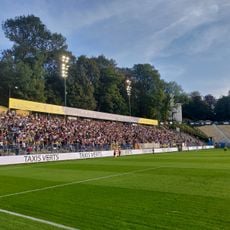
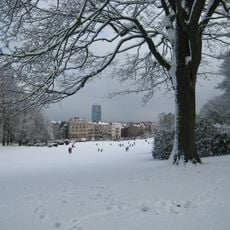
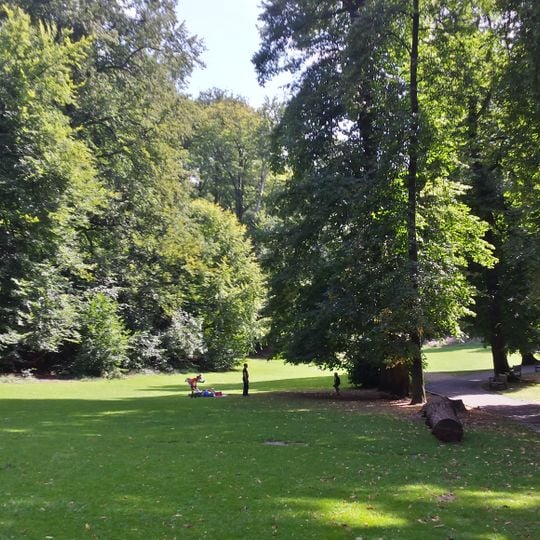
Duden Park covers about 24 hectares on the right flank of the Senne valley in Forest, sloping from 55 m at its lowest point to 90 m at its highest. It holds the 19th-century Duden Castle, the Villa Mosselman and the Joseph Marien Stadium, home ground of Royale Union Saint-Gilloise. The photograph shows an open lawn bordered by tall trees, with a broad gravel path and cut logs beside a massive trunk.
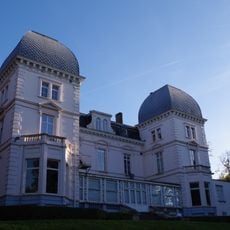
The wooded slope was once part of the Heegdebos, an offshoot of the Sonian Forest, and belonged to Forest Abbey until the end of the 18th century. After passing through banker Edouard Mosselman, the estate was bought in 1869 by German canvas merchant Wilhelm Duden, who built the neoclassical Duden Castle. He left it to King Leopold II on condition it become a public park, which opened in 1912.
The park's name comes from Wilhelm Duden, the German grain merchant who bought the estate in 1869 and left it to King Leopold II on condition it become a public park bearing his name. The castle now houses part of HELB-INRACI and NARAFI, Belgium's two oldest film schools.
The park lies on a slope of the Senne valley, dropping from 90 m at the top to 55 m at the lowest point, so expect climbs on the way back up. It is reached by the Albert premetro station, tram 82 at Zaman-Forest National, and buses 48 and 54. The Lainésquare entrance, built in 1949, connects it directly with Forest Park.
The park's original name, Kruysbosch or Cruysbosch, referred to a stone cross erected in 1491 by Jan Vranckx out of remorse for murdering the priest Jan Paridaens. That cross stood in the former woodland, not in today's park, so no medieval cross is to be found among the lawns and paths.
The community of curious travelers
AroundUs brings together thousands of curated places, local tips, and hidden gems, enriched daily by 93,554 contributors worldwide.