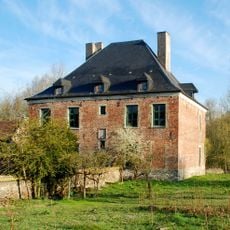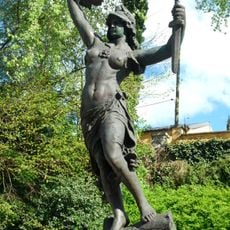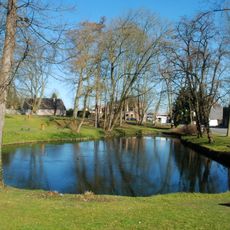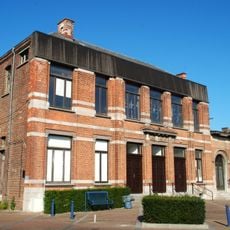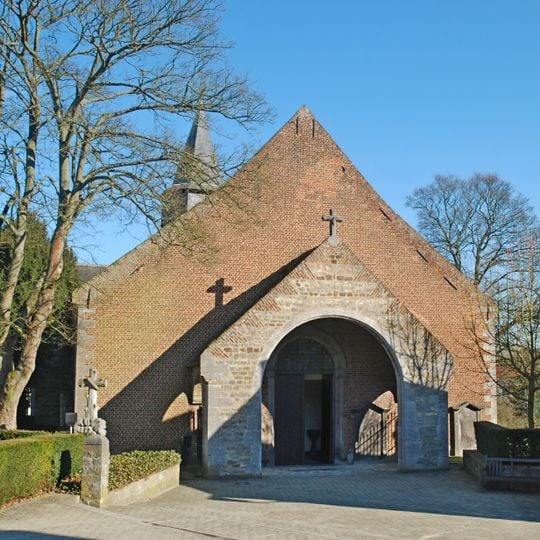
Église Notre-Dame de Mousty, Romanesque church in Mousty, Ottignies-Louvain-la-Neuve, Belgium
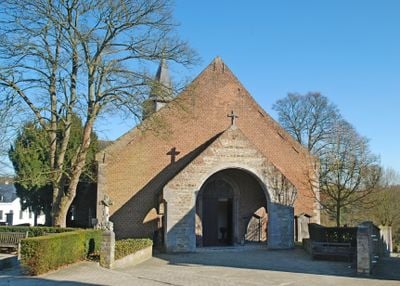
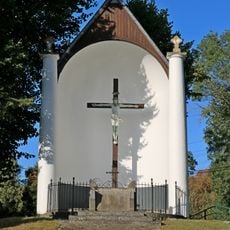
Notre-Dame de Mousty is a Mosan Romanesque church whose lower chevet and transept are built of rubble set in opus incertum, with fragments of Roman tiles and bricks reused in the masonry. The upper walls, rebuilt in brick in 1744, carry a dentil frieze, and the western facade of 1771-1772 has a modern porch added in 1937. A stone funeral monument topped by a wooden-style stone cross stands before the facade.
The Mosan Romanesque church dates from the 11th century, probably replacing a wooden church of which no trace remains. It was transformed in the Classical period, with works dated 1729, 1744 and 1772, when the nave floor was raised two metres and a narthex added. The choir, transept, nave and crypt were listed on 29 May 1952, and the whole building except the porch on 25 June 1986.
The name Mousty comes from the Latin monasterium, recorded as Moustiers in 1230, possibly recalling a small chapter of canons the church depended on between the 11th and 13th centuries. The triangular place de l'Église once held the presbytery, the first village school, a farm and an inn; paved and planted with a Liberty tree, it was narrowed in 1970 when the rue de la Station was widened and now serves as a car park.
The underground crypt can be entered from the nave and is lit by windows cut into the walls long ago. You can walk through these preserved spaces to see the original construction method.
Stones from the ancient Roman villa were reused and built directly into the church walls, most notably in the square chevet. This practice of recycling old materials was common in medieval construction.
The community of curious travelers
AroundUs brings together thousands of curated places, local tips, and hidden gems, enriched daily by 95,380 contributors worldwide.