Hamal Castle, Medieval castle in Rutten, Tongeren, Belgium.
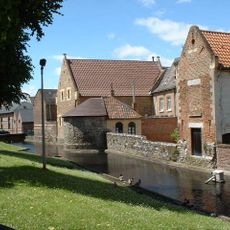
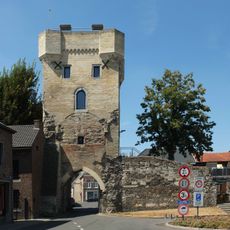
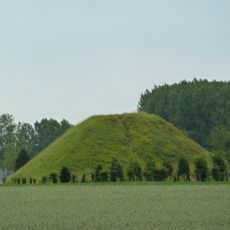
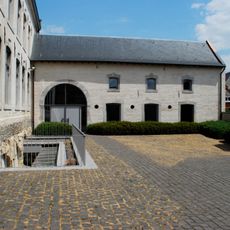
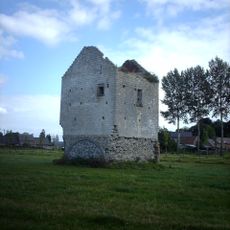
Hamal Castle is a moated brick building of 1770, built for baron De Haxhe, with a symmetrical north-facing facade flanked by two corner towers topped with onion-shaped domes. South of it stands the 12th-century donjon, rebuilt in 1770, in flint blocks with limestone corner bands and marlstone wall fragments. The house contains a neo-Gothic chapel of 1879 and a glass gallery of 1865.
Hamal Castle was first documented in 1214, when Frederick II took it during his struggle with Otto IV and Henry I of Brabant surrendered there. The castle was destroyed by militias from Tongeren, Dinant and Huy in 1346, again by Liège troops in 1364, and partly by Dutch Republic forces in 1676. Baron De Haxhe gave the building its classicist form in 1770.
The castle served as the seat of the lords of Rutten and shaped local governance for centuries. People in the area still see it as a symbol of their region's medieval past.
The castle is private property with limited public access, but the surrounding English park with its moat and bridge can be viewed from outside. Visit during warmer months when the park grounds are most inviting for a walk around the perimeter.
The 12th-century keep south of the present house is the oldest surviving part: built of flint blocks with limestone corner bands and restored marlstone wall fragments, it was remodelled by Baron De Haxhe in 1770. The 1770 house itself has a trompe-l'oeil staircase painted in 1771 by Caldelli.
The community of curious travelers
AroundUs brings together thousands of curated places, local tips, and hidden gems, enriched daily by 94,416 contributors worldwide.