Sint-Waldetrudiskerk, Gothic parish church in Herentals, Belgium.
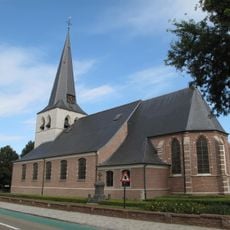
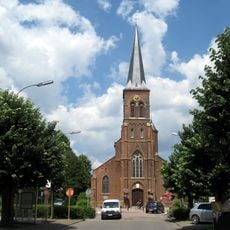
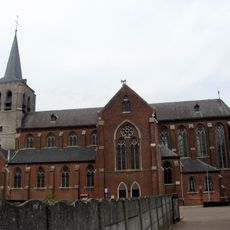
Sint-Waldetrudiskerk is a Brabantine Gothic basilica with a low crossing tower set between the choir and the nave, built of Balegem sandstone and covered in slate. The choir, with ambulatory and side chapels, dates from 1417–1449, while the three-aisled nave of seven bays began in 1453. The west gable holds a statue of the patron saint (1978, M. Peeters), and the tower carries a needle spire added in 1901.
Construction began in the 14th century with the unusual crossing tower, built before the transepts and nave. The choir, attributed to Gillis van den Bossche, was completed in 1449; the three-aisled nave followed from 1453. After the east choir decayed under the States-General (1576–1584), it was closed with a brick wall, dated 1626 and 1646. A sacristy was added in 1785.
The church keeps nine paintings by the Herentals Francken family of painters, active in the 16th and 17th centuries, several of them triptychs. Its best-known work is the Brussels altarpiece made around 1520 by Passier Borreman, showing the martyrdom of Saints Crispinus and Crispinianus, patrons of shoemakers and tanners. The twenty side altars were filled with Francken workshop paintings after 1584.
Access to the church is through Kerkplein in central Herentals, with doors mainly open on Friday through Sunday afternoons. It is wise to check exact visiting times in advance, as these can vary depending on the season.
The crossing tower, the only surviving 14th-century element, stands between choir and nave rather than at the west end, an unusual choice for Brabantine Gothic. The 1901 needle spire replaced a bell-shaped top of 1796. The nave and choir also sit at an oblique angle to the low transept.
The community of curious travelers
AroundUs brings together thousands of curated places, local tips, and hidden gems, enriched daily by 93,891 contributors worldwide.