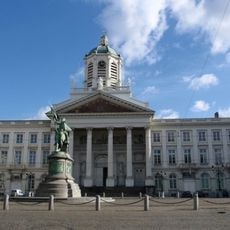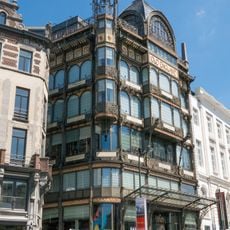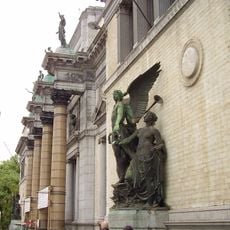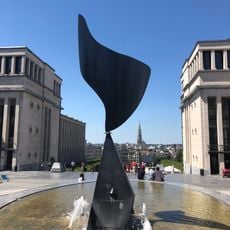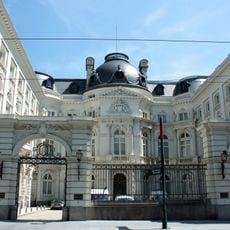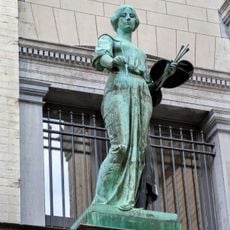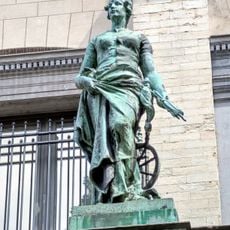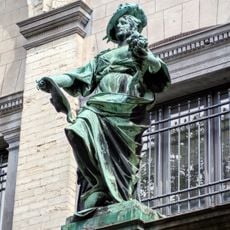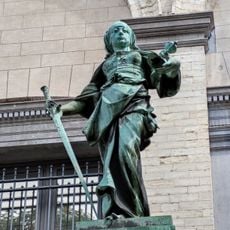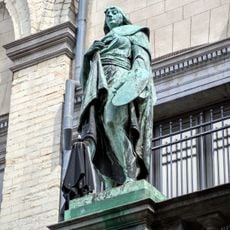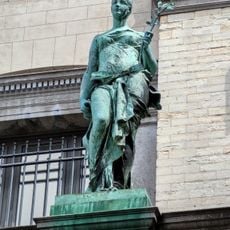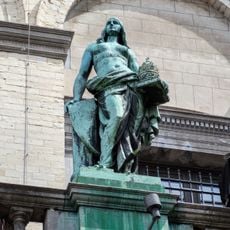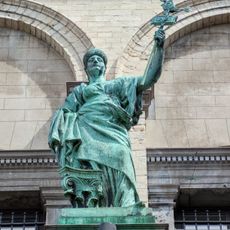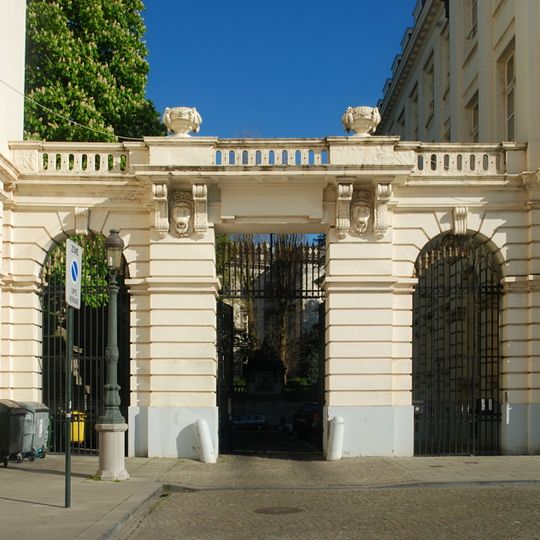
Portiques de la place Royale de Bruxelles, Neoclassical porticos at Place Royale, Brussels, Belgium.
The Portiques de la place Royale are four gateways at the corners of Brussels' Place Royale, built 1776–1780. Each has a low central passage under a flat entablature, flanked by taller round-arched openings with iron grilles. The cream stone carries horizontal grooved bands, carved heads at the arch springs, and a balustrade topped by urn-shaped finials.
The four porticos belong to the neo-classical Place Royale built between 1775 and 1782 on the site of the Coudenberg Palace, which burned in 1731. The Austrian authorities approved the project in 1774 under Maria Theresa. Jean-Benoît-Vincent Barré drew the base plan and Barnabé Guimard the detailed ones. The Spangen portico was built in 1776–1777, the Borgendael one in 1777–1778 and rebuilt in 1880, and those of the Rue du Musée and Rue de Namur in 1780.
The four porticos are named after the streets and buildings they adjoin: rue du Musée, rue de Namur, impasse du Borgendael and the Hôtel de Spangen. Each was financed by a different patron, among them the Count of Spangen, the Countess of Templeuve and the brewers' guild. Visitors can still read the square as a catalogue of these private and corporate contributions.
You can reach the arcades easily on foot from central Brussels or via the Central Station and Parc metro stops nearby. The square is best visited early in the day when it is less crowded.
The Hôtel de Spangen, one of the four structures, was built for a count between 1776 and 1777 and remains unrestored to this day. This gives it a noticeably different appearance from its three neighboring porticos.
The community of curious travelers
AroundUs brings together thousands of curated places, local tips, and hidden gems, enriched daily by 93,703 contributors worldwide.