Parc Louise-Marie, Public park in Namur, Belgium.
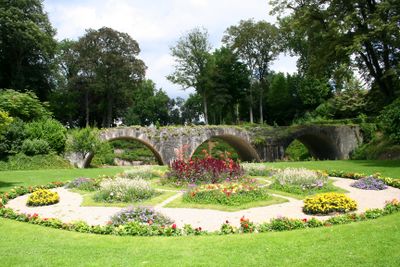
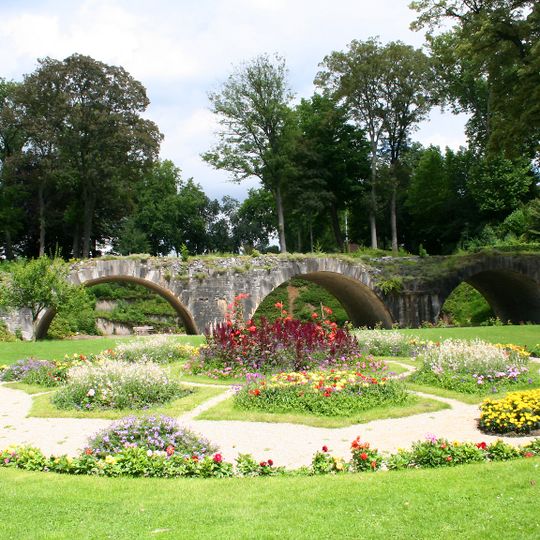
Parc Louise-Marie is a two-level park in Namur designed by landscape architect Constantin Smits. At its centre a pond marks the line of the former moat, with an artificial grotto on its east side. The stone bridge built between 1815 and 1820, once leading to the Brussels Gate, was uncovered in the 1990 restoration and now stands above formal flower beds.
The park was created in 1879–1880 after Namur's 14th-century ramparts were demolished and the outer moat filled. A design competition was won by landscape architect Constantin Smits, who laid out a two-level park with a rural appearance on the former fortification ground.
The park is named after Louise-Marie d'Orléans, Belgium's first queen, wife of Leopold I. Its south-east side runs along the Rempart de la Vierge, a street name recalling the 14th-century ramparts demolished to create the park. The bronze plaque on the staircase to Avenue de Stassart shows the engraver Félicien Rops, whose garden stair it copies.
The park lies along the Rempart de la Vierge on its south-east side, with the Avenue de Stassart stair on the west and the children's playground on the south-west side toward the Sambre. It is built on two levels, so reaching the upper part means climbing; the Rops stair is a copy of the one he drew for his garden at la Demi-Lune in Corbeil-Essonnes.
The bridge visible in the park was built between 1815 and 1820 under Dutch rule and once led to the Brussels Gate. It was buried when the moat was filled in, then excavated during the 1990 restoration. Its three arches now stand among the flower beds.
The community of curious travelers
AroundUs brings together thousands of curated places, local tips, and hidden gems, enriched daily by 94,232 contributors worldwide.