Brigidakapelle, Church building in Berlotte, Belgium
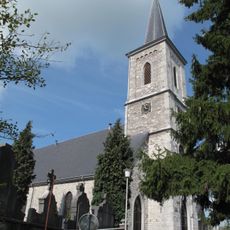
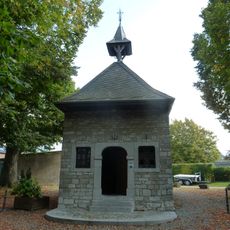
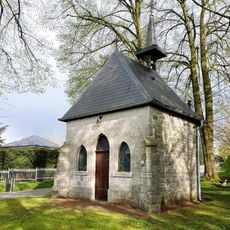
Brigidakapelle is a small chapel of rough rubble stone with blue-stone corner quoins and window frames, standing in the hamlet of Berlotte. The two-bay nave is extended by a narrower single-bay choir, and a square bell turret with louvered openings and a wrought-iron cross rises from the roof ridge. The entrance door is rectangular, flanked by small hatches and topped by a round window.
Johann Wildt, mayor of Eynatten, left 50 talers at his death in 1695 for a first chapel in Berlotte; with further donations the chapel was built in 1711 under pastor Cornelius Matthei and dedicated to the Holy Family. In 1721 Archbishop of Cologne Joseph Clemens von Bayern allowed weekday Masses, and a year later the building was lengthened by eight metres, the year carved into the door lintel. Sunday Masses were permitted from 1748.
The annual Berlotter Kirmes is held on the first Sunday in August, and its proceeds still cover most of the chapel's upkeep. The chapel is dedicated to Saint Brigid, though it was first built in honour of the Holy Family. A cross of woven wire on the entrance side was part of the death strip between East and West Germany for 28 years and was given to Berlotte in 2003.
The building sits between Eynatten and Berlotte and is reachable by walking paths from different directions. The location lies in the German-speaking region of Belgium, making it straightforward to visit.
On the entrance side hangs a cross woven from chain-link fencing that stood for 28 years in the death strip between East and West Germany in Thuringia. On 1 May 2003 a delegation from Heilbad Heiligenstadt, with mayor Bernd Beck, presented it to the people of Berlotte for their chapel.
The community of curious travelers
AroundUs brings together thousands of curated places, local tips, and hidden gems, enriched daily by 94,346 contributors worldwide.