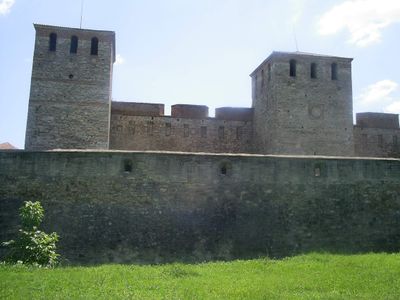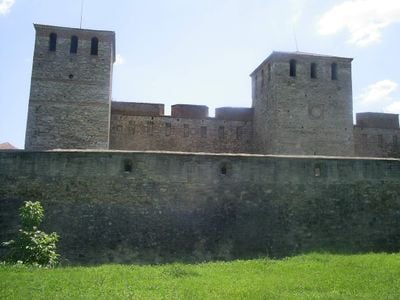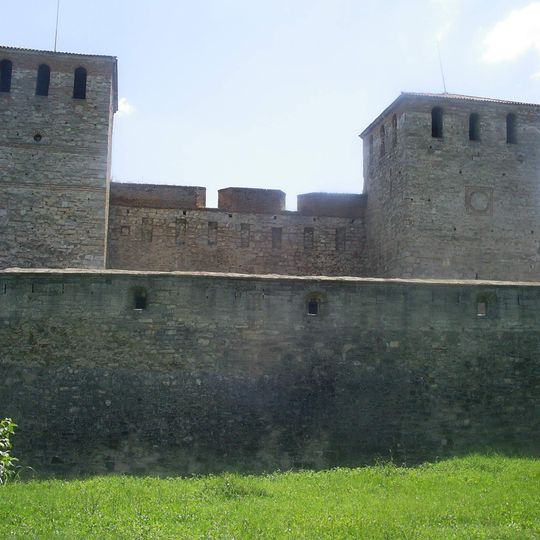
Baba Vida, Medieval fortress on Danube riverbank in Vidin, Bulgaria.
Baba Vida is a medieval castle on the Danube bank in Vidin, built of rough grey and tan stone blocks. Two concentric curtain walls enclose a trapezoid plan about 60–65 m wide and 80 m long, with four towers, four bastions and a water-filled moat 12 m wide and 6 m deep. The best-preserved tower, the 16 m Sratsimirova Tower, stands at the northern tip of the inner wall; the three-storey Entrance Tower and the octagonal Austrian Tower sit on the outer wall.
The fortress dates to the 10th century, constructed on the remains of the Roman fort Bononia that once occupied this location. It underwent multiple reconstructions and expansions during the rule of Bulgarian and Ottoman empires over the centuries.
The castle's name comes from a legend about three sisters: Vida, Kula and Gamza, who inherited a ruler's lands, and Vida built the castle in Vidin. The Ottomans called the citadel the Virgin Fortress because it was never taken by force. Finds from the site include bones of capercaillie and common crane, and a 26 cm grey-white limestone sculpture of a human head set into the Voynishka Tower facade 12 m above its base, found in 1992.
The fortress is accessible year-round, though warmer months are best for exploring the outer walls and towers comfortably. Wear comfortable shoes, as reaching some areas involves climbing stairs and walking on uneven ground.
This fortress resisted conquest through centuries of conflict and remains the only completely preserved medieval castle in Bulgaria. This rare survival makes it an exceptional example of regional medieval fortification design and construction techniques.
The community of curious travelers
AroundUs brings together thousands of curated places, local tips, and hidden gems, enriched daily by 93,471 contributors worldwide.