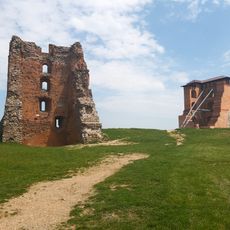
Замковая церковь, Eastern Orthodox church in Navahrudak, Belarus.
Zamkovaya Church was a cross-shaped Orthodox church, 12.2 by 13 metres, on Navahrudak Castle hill. Its red baked-brick walls had side projections faced with yellow-green tuff blocks, and four interior pillars supported a drum and dome. A 17th-century rebuild extended it west and added a tower over the south wall. Only foundations survive, over a metre deep.
The church was probably begun under Grand Duke Gediminas before 1323, when Navahrudak was still the capital of the Grand Duchy of Lithuania. In the second half of the 14th century four central pillars were added. It was rebuilt in the late Baroque style in the 17th century, badly damaged by fire in 1751, and demolished for brick in the early 1870s; only its foundations remain, over a metre below the surface of Castle Hill.
From the 16th century the church held the wonder-working icon of the Mother of God of Navahrudak, credited with many miracles, including the recovery of Adam Mickiewicz. Between 1581 and 1775 the Lithuanian Tribunal met here. The building was demolished in the early 1870s; only its foundation survives, over a metre below the surface of Castle Hill.
The church no longer stands: it was dismantled for brick in the early 1870s, and only its foundations survive, buried more than a metre deep on Castle Hill in Navahrudak. Look for the excavated footings among the castle ruins; there is no interior, entrance or roof to visit. The remains were studied by Leningrad archaeologists in 1973–1974.
The church was demolished for brick in the early 1870s; only its foundations survive, buried more than a metre deep on Castle Hill. Archaeologists from Leningrad excavated them in 1973–1974, revealing the plan of a 12.2 by 13 metre building.
The community of curious travelers
AroundUs brings together thousands of curated places, local tips, and hidden gems, enriched daily by 94,607 contributors worldwide.