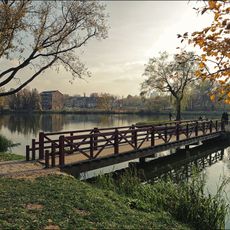
Manor of Adadurov, Neoclassical manor house in Minsk, Belarus.
The Manor of Adadurov, also called Belaya Dacha, is a one-storey brick manor house on Kazintsa Street 54 in Minsk, built in the late 19th century. Its asymmetrical composition ends in a tall octagonal tower with a balcony and crenellated parapet, and the facades are decorated with rustication, profiled bands and rosettes. Arched window and door openings have moulded surrounds, and the rooms are grouped around a central vestibule.
Built in the late 19th century as a country house for Nikolai Adadurov, head of the Libau-Romny railway, the estate gave its name to the nearby settlement Zastenok Adadurova. During the Russo-Japanese War it was consecrated as a hospital. A stone single-storey building was added in 1912–1913 for Moisei Rogov, and after nationalisation the site housed an agricultural school and later the Institute of Soil Science and Agrochemistry.
The name Kurasovshchina comes from Jan Kurash, an early owner of these lands, not from a landowner Kurasov. From 1990 the house held the Centre of Belarusian Folklore. Since the 2000s, stage events mark state holidays beside the building.
The estate is accessible by public transport from central Minsk and sits in a quiet residential neighborhood. Wear comfortable shoes for walking and allow time to explore the grounds and gardens around the property.
In May to mid-June 1947 the landscape painter Vitold Byalynitsky-Birulya lived and worked at the manor, painting several dozen studies that became the basis of a cycle of pictures about Belarus, among them "Green May" and "Apple Trees in Bloom". The painter Anton Barkhatkov accompanied him and also painted views of Kurasovshchina.
The community of curious travelers
AroundUs brings together thousands of curated places, local tips, and hidden gems, enriched daily by 94,611 contributors worldwide.