Lutheran church St. John in Grodnо, Gothic Revival Lutheran church in Grodno, Belarus
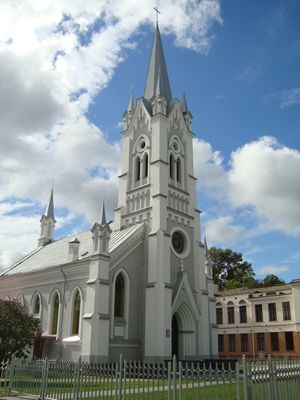
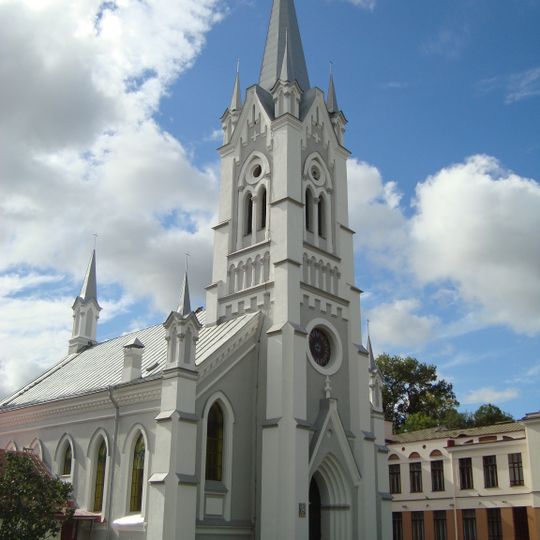
St. John's Lutheran Church is a single-nave, single-tower brick church with a five-sided apse and sacristies, its square bell tower rising from the main volume to a tall pointed spire. The main entrance through the tower has a large pointed portal with a rose window above, and the side walls are reinforced by buttresses. Inside, the rectangular nave is covered by a shaped vault that passes from a cylindrical ceiling at the side walls to a flat wooden-corbel ceiling, with small choir galleries on the tower's second floor.
Lutherans arrived in Grodno in 1779 from Germany at the invitation of starosta Antoni Tyzenhauz to work in the royal manufactories. In 1793 King Stanisław August Poniatowski gave the community a former tavern building, adapted as a church. The stone Neo-Gothic church was completed by 1843, a clock was added to the tower in 1873, and a major reconstruction followed in 1912. After 1944 the building housed the Grodno regional archive until 1994; it was returned to the Lutheran community in 1995 and restored in 2013–2015.
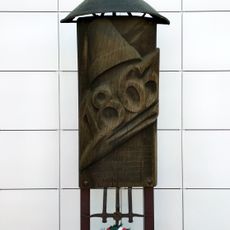
The street around the church was named Kіrchavaya after it, and services were first held in German because most parishioners came from Germany. Two original stained-glass windows behind the altar survive, their pattern forming the Luther rose: a heart with a cross inside a rose. A wrought-iron font, the bell and the tower clock also remain.
The church stands at May 1 Street 5, in the Gorodnitsa suburb of central Grodno. The main entrance is through the square bell tower, under a large pointed portal with a rose window above. Inside, the nave is covered by a shaped vault that passes from a cylindrical ceiling at the side walls to a flat wooden ceiling. The two original stained-glass windows behind the altar show the Luther rose.
Two original stained-glass windows behind the altar survive, their pattern forming the Luther rose: a heart with a cross inside a rose. The wrought-iron baptismal font, the bell and the tower clock also remain; the organ was confiscated in Soviet times for the philharmonic.
The community of curious travelers
AroundUs brings together thousands of curated places, local tips, and hidden gems, enriched daily by 94,451 contributors worldwide.