Cape Race Lighthouse, Historic lighthouse at Cape Race, Newfoundland and Labrador, Canada.
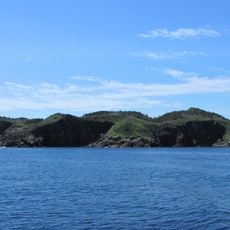
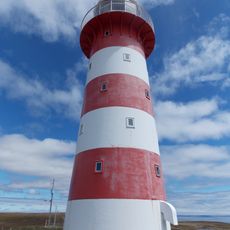
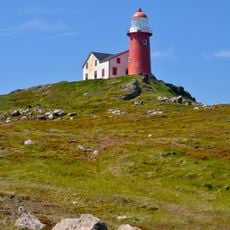
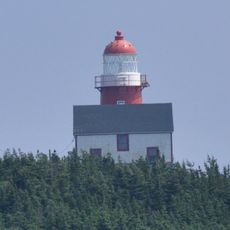
Cape Race Lighthouse is a 29-meter concrete tower painted white with red accents that rises from a rocky headland on the far eastern coast. The structure houses optical equipment and is accompanied by an interpretive center that explains maritime history and navigation to visitors.
The first lighthouse here was a cast iron tower installed in 1856 by Trinity House, with a coal oil lamp turned by clockwork. In 1907 it was replaced by the current 29-metre concrete tower, fitted with a hyperradiant Fresnel lens by Chance Brothers. In April 1912 the station received the Titanic's distress call. The original tower was moved to Cape North and now stands outside the National Science and Technology Museum in Ottawa.
The red house beside the tower is a replica of the Canadian Marconi Company wireless station built in 1904; the original burned soon after 1912. It now holds a museum on the history of telegraphy at Cape Race and draws visitors interested in the Titanic, whose distress call was received here in April 1912. Newfoundland Post issued a "Transatlantic Beacon" stamp showing the lighthouse in 1932, 1937 and 1941.
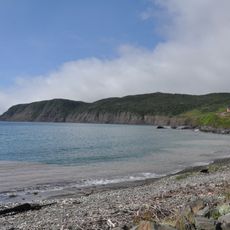
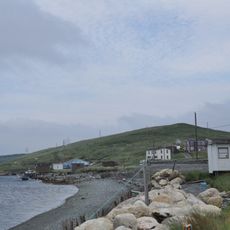
The lighthouse is reached by a 20-kilometer road from Route 10 and sits on an exposed headland with strong coastal winds. Visitors should dress warmly and wear sturdy footwear, as the terrain is rocky and conditions can be windy throughout the year.
The 1907 optic was a hyperradiant Fresnel lens made by Chance Brothers of England, emitting a one-million-candlepower flash. In 2006 David Myrick, with Noel and Liam Myrick, gave wood from the cabinet housing the lens's drive motor to the Six String Nation project; it forms the heel brace of the guitar Voyageur.
The community of curious travelers
AroundUs brings together thousands of curated places, local tips, and hidden gems, enriched daily by 94,320 contributors worldwide.