Cape Pine Light, National historic lighthouse in Cape Pine, Canada.
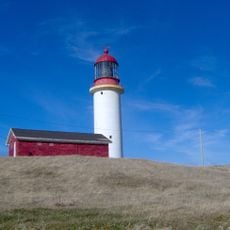
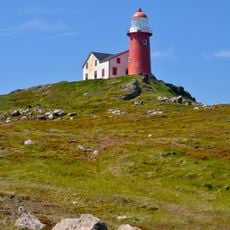
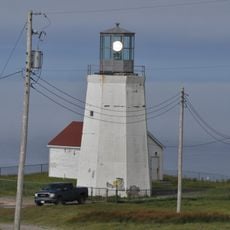
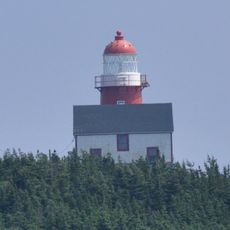
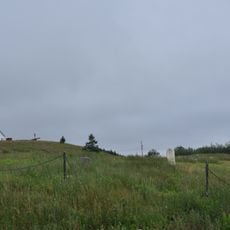
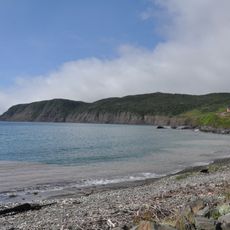
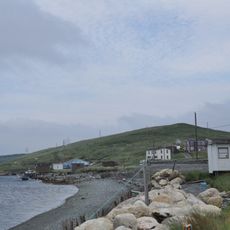
Cape Pine Light is a prefabricated cylindrical cast iron tower, 15.3 m tall, painted white with red horizontal bands, topped by a polygonal lantern. It stands at the edge of a 315-foot black slate cliff at the southern tip of the Avalon Peninsula, between St. Mary's Bay and Trepassey Bay.
Cape Pine Light was built in 1851 to designs by the British architect and engineer Alexander Gordon, after the Newfoundland House of Assembly petitioned London for help from 1840 and secured it in 1847. The Admiralty's concern followed the wreck of the troopship HMS Harpooner near the cape in dense fog after the War of 1812, with over 350 deaths, and further losses in the 1820s and 1830s. It was Newfoundland's first prefabricated cast iron lighthouse and was designated a National Historic Site in 1974.
The light's keepers were the Hewitt family for over a century: George Hewitt took over in 1866, followed by George J., George T. and Valentine Hewitt until 1973. Michael Myrick succeeded him, and the Myrick family has kept the light since, with Rick Myrick on duty from 2011.
Cape Pine Light lies about 25 km southwest of Trepassey, reached by an 8 km gravel road; the access road comes from that direction, not from the south along the shore. The tower stands at the edge of a 315-foot black slate cliff, so keep back from the brink in fog and wind. Sturdy footwear suits the gravel surface.
Cape Pine Light was the first prefabricated cast iron lighthouse in Newfoundland; the design by Alexander Gordon was repeated in later nineteenth-century towers, while the twentieth century switched to reinforced concrete. Its keepers came from a few local families: the Hewitts held the post from 1866 to 1973, followed by the Myricks.
The community of curious travelers
AroundUs brings together thousands of curated places, local tips, and hidden gems, enriched daily by 94,616 contributors worldwide.