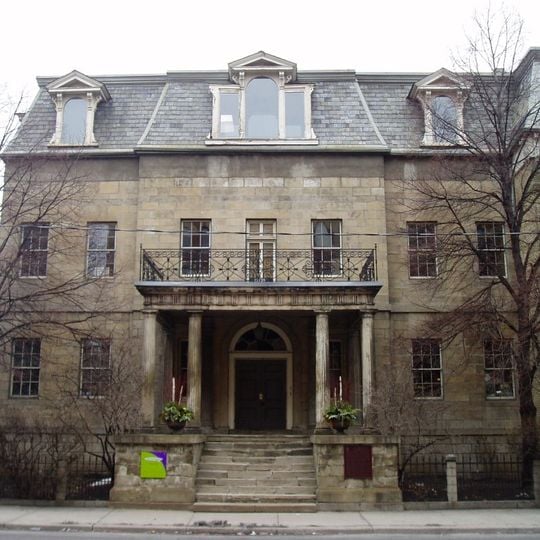
Bank of Upper Canada Building, National historic site in downtown Toronto, Canada.
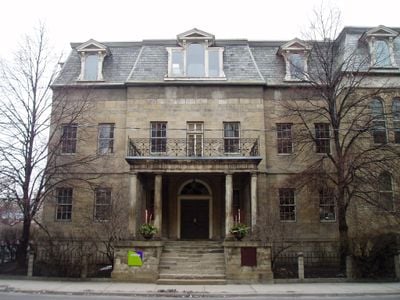
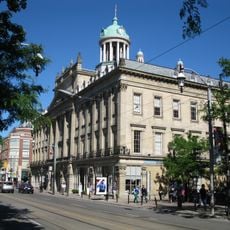
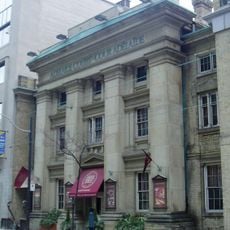
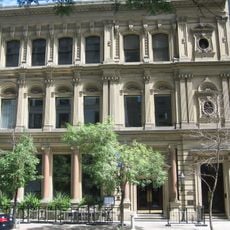
The Bank of Upper Canada Building is a three-storey limestone building at 252 Adelaide Street East, with a symmetrical neoclassical facade of roughly coursed light brown stone above a raised base. Its central entrance has a projecting portico of four columns on tall bases, a balcony with black metal railing and a recessed round-arched doorway with fanlight. The grey slate roof carries a central gabled dormer and two pedimented dormers. The design is attributed to William Warren Baldwin, possibly Francis Hall; the Doric portico was added in 1843 by John George Howard.
The bank opened in 1821 in a nearby store and moved into this building in 1827, when it was one of the few stone buildings in York. During the 1837 rebellion, William Lyon Mackenzie's Reformers marched down Yonge Street intending to seize the gold stored here, but failed. The bank failed in 1866 and was put into receivership; the property was sold in 1870 to the De La Salle Brothers, who built a Roman Catholic boys' school next door in 1871.
The building shows early Canadian banking design through paired columns and a raised entrance podium that reflected the institution's importance. These features were typical of financial buildings meant to convey security and trustworthiness to visitors.
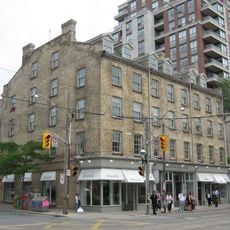
The building is located on Adelaide Street East in Toronto's Old Town district and is easily recognizable from the street. Since it now houses commercial offices, visitors should check accessibility before visiting.
During the 1837 rebellion, William Lyon Mackenzie and his Reformers marched down Yonge Street intending to seize the gold kept in the bank; the attack failed. The building is also considered probably the oldest surviving building erected as a bank in Canada.
The community of curious travelers
AroundUs brings together thousands of curated places, local tips, and hidden gems, enriched daily by 94,111 contributors worldwide.