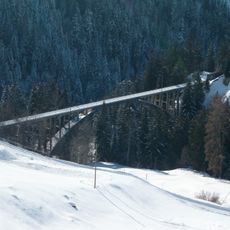
Langwieser Viaduct, Railway bridge in Langwies, Switzerland.
The Langwieser Viaduct is a single-track reinforced concrete railway bridge on the Chur–Arosa line, crossing the Plessur and the Sapünerbach just beyond Langwies station. Its 284 m length includes a 100 m main arch with a 42 m rise, 13 openings and a deck 3.7 m wide, 62 m above the valley floor.
The Chur–Arosa line was the last of the Rhaetian Railway's core network to be built, and the viaduct was erected between 1912 and 1914 by the contractor Züblin under engineer Hermann Schürch, with static calculations by Karl Arnstein. Its 100 m main arch made it the first concrete railway bridge of that span anywhere. The line merged into the RhB in 1942, and the bridge is now a Swiss heritage site of national significance.
The viaduct is named after Langwies, the village whose station sits directly at its eastern end on the Chur–Arosa line. The line was built by the private Chur-Arosa Bahn (ChA), which merged with the Rhaetian Railway in 1942 for financial reasons. The bridge is listed as a Swiss cultural property of national significance.
The viaduct stands immediately up the line from Langwies station, where the metre-gauge Chur–Arosa train crosses it; walkers reach the site on footpaths from Langwies through the Plessur valley. The bridge is 284 m long with 13 openings, so the full arch is only visible from a distance. Access roads are narrow and steep, and the site is supplied from Chur by road.
The timber falsework for the main arch was built by carpenter Richard Coray of Trin and used 800 cubic metres of wood; contemporaries regarded it as an achievement in its own right. In the final loading test a steam locomotive and three loaded freight cars caused a deflection of less than 1 mm.
The community of curious travelers
AroundUs brings together thousands of curated places, local tips, and hidden gems, enriched daily by 92,757 contributors worldwide.