Lai da Nalps, Reservoir in Tujetsch, Grisons, Switzerland
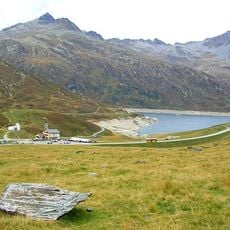
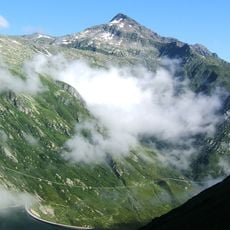
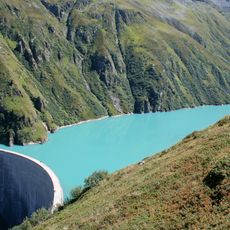
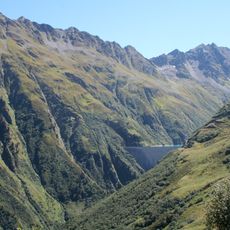
Lai da Nalps is a large water reservoir in Tujetsch, Switzerland, situated at approximately 1,900 meters elevation and covering about 0.9 square kilometers. The basin holds up to 45 million cubic meters of water and sits in a narrow mountain valley where steep rock walls drop directly into the water, with small plants and boulders clinging to the shoreline.
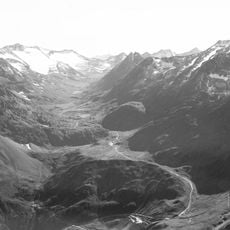
The Val Nalps was barely developed before the reservoir was built; the flooded valley floor had served only as alpine pasture. The 127-metre-high arch dam was completed in 1962, creating a reservoir fed by water diverted from Lai da Curnera and Lai da Sontga Maria. Since 2002 lasers and reflectors have monitored the dam automatically, partly to detect deformation from the Gotthard Base Tunnel, whose tubes run 400 metres east and 1,200 metres below the wall; cracks were found in 2009.
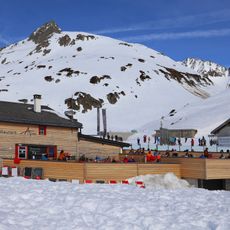
The name is Romansh: "lai" means lake, and the valley name Nalps belongs to the Sursilvan-speaking Tujetsch area. Before the dam, Val Nalps was barely developed and the flooded ground served only as alp pasture. The winter cable car to Alp Tgom, once carrying summer passengers to a mountain restaurant, is now used mainly by the power company.
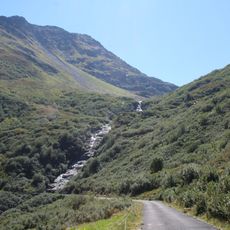
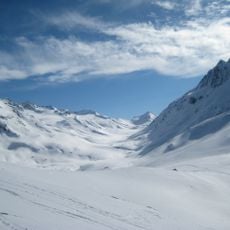
A mountain road runs from Surrein up to the lake, about five kilometres south of Sedrun, but a general driving ban applies from the entrance to Val Nalps. In winter the road is not kept open, so from roughly December to May the Nalps dam can only be reached by a private cable car; its first section to the Tgom intermediate station can be used by private individuals on request.
The reservoir connects to two nearby lakes, Lai da Sontga Maria and Lai da Curnera, through underground tunnels in a hidden water management system. These unseen connections allow the system to direct water between the lakes and optimize power generation across the entire region.
The community of curious travelers
AroundUs brings together thousands of curated places, local tips, and hidden gems, enriched daily by 94,070 contributors worldwide.