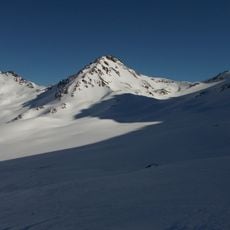
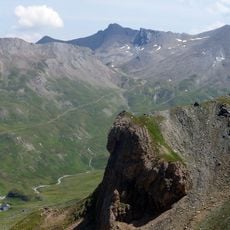
Piz Tschütta, Alpine summit in Grisons, Switzerland
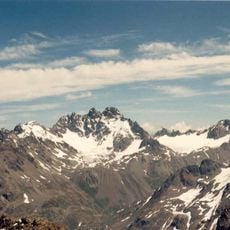
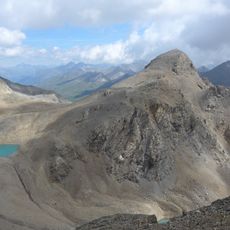
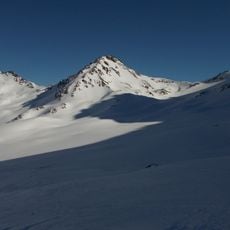
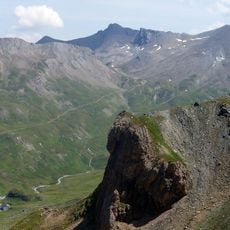
Piz Tschütta is a mountain in the Samnaun Alps that rises to about 3254 meters with steep slopes and exposed rock faces. The climb requires technical skills and involves scrambling over rough terrain where handholds become necessary.
Early attempts to reach the summit are recorded by A. Arquint and later by Gustav Gröger in 1879, who looked for a route on the north-west flank. On 16 August 1884 K. Schulze of Leipzig, with Johann Nell and Seraphim Kuppelwieser, made the first ascent of the higher eastern summit. The lower western summit had already been reached in 1881 by the Briton John Percy Farrar, Alois Praxmarer from the Kaunertal and Heinrich Prinz from Samnaun.
The Romansh name Piz Tschütta comes from the Vallader idiom of the Engadin; German speakers call the same peak Stammerspitze or Stammerspitz. The mountain lies entirely in the municipality of Samnaun, and the lower 3147 m west summit is sometimes called Piz Tschütta on its own, in distinction to the main summit.
Summer months offer the best conditions for climbing, when snow and ice are minimal and the weather is more stable. Climbers need basic equipment such as rope, carabiners, and a helmet, and should plan the route beforehand.
The summit lies entirely within the municipality of Samnaun in Grisons, about 3 km west of the Muttler, the highest peak of the Samnaun Alps. Its Romansh name in the Vallader idiom is Piz Tschütta, while the 3147 m western fore-summit is sometimes called Piz Tschütta on its own.
The community of curious travelers
AroundUs brings together thousands of curated places, local tips, and hidden gems, enriched daily by 94,226 contributors worldwide.