Collégiale de Neuchâtel, Gothic church in Neuchâtel, Switzerland
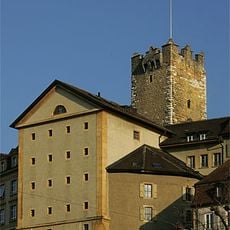
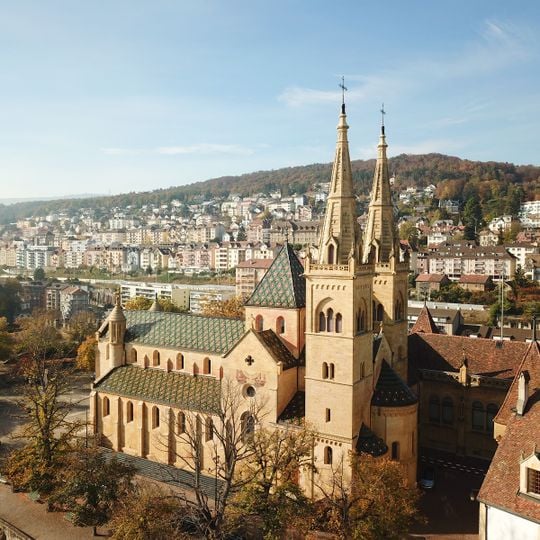
The Collégiale de Neuchâtel is a three-nave basilica with twin towers, a prominent crossing tower with its own windows, and a roof of coloured glazed tiles. Construction began around 1190 in Rhenish Romanesque style; the upper parts and the surviving Gothic cloister to the north date from later campaigns. The south tower was built in the second half of the 13th century, the north tower only in 1867–1870.
Construction began around 1190 under Count Ulrich II and his wife Berthe, starting with the choir, apse, lower transept and eastern bays; the nave's west gable and porch were finished around 1270-1280. The building mixes Rhenish Romanesque with Burgundian forms, such as the glazed tile roof, while the upper parts and cloister are Gothic. In 1530 the town's burghers voted for the Reformation under Guillaume Farel, and the collegiate chapter was suppressed.
The cenotaph of the Counts of Neuchâtel stands in the choir, built in 1372 by Count Louis of Neuchâtel for his family. It holds 14 polychrome statues and one monochrome figure: Louis is surrounded by his three successive wives, and the leftmost countess lacks a chin strap. Nearby lie two raised effigies, likely his parents Rodolphe IV and Éléonore de Savoie. Four armoured knights, probably his three sons and his son-in-law, flank the sides.
The church is accessible on foot, and visitors can easily spot the main entrance with the large rose window as an orientation point. The interior layout is straightforward to navigate, though certain areas like the choir section may have limited access during services.
The four bells are split between the two towers: the three historic bells hang in the south tower, while the second-smallest (ges3) was cast for the 400th anniversary of the Reformation in Neuchâtel and placed in the north tower, built only in 1870, which had never held a bell before.
The community of curious travelers
AroundUs brings together thousands of curated places, local tips, and hidden gems, enriched daily by 93,692 contributors worldwide.