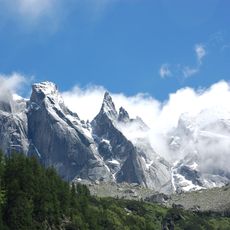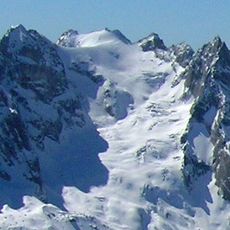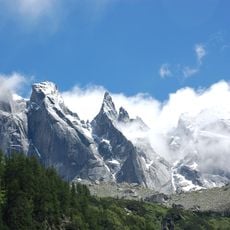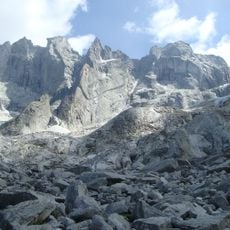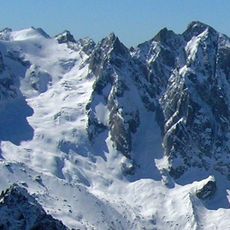
Piz Badile, Granite mountain summit in Val Bregaglia, Switzerland.
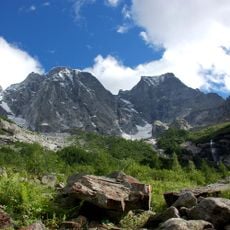
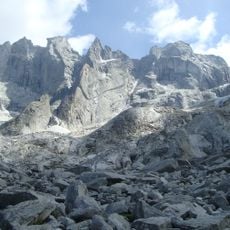
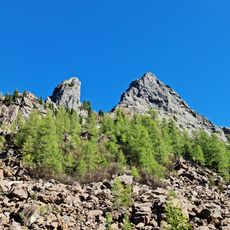
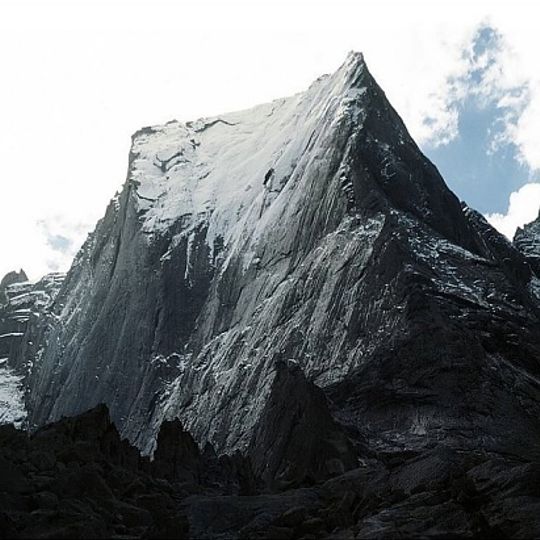
Piz Badile is a granite summit on the Swiss-Italian border, reaching 3,308 metres between Val Bondasca to the north and Val Masino to the south. Its north face rises over 700 metres above two glaciers, the Vadrec da la Trubinasca and the Vadrec dal Cengal. The upper slabs narrow into a funnel, giving the mountain the shovel shape behind its name. The rock is Bergell granite, a granodiorite with large potassium feldspar crystals.
The first ascent was made on 26 July 1867 by W. A. B. Coolidge with the guides François and Henri Dévouassoud, via the south flank. The north ridge, over 1,200 m long, was first climbed on 4 August 1923 by Alfred Zürcher and Walter Risch. In July 1937 Riccardo Cassin's team opened the north-east face route, and two of the five climbers died during the descent.
The name comes from the mountain's shape: 'Badile' means shovel in Italian, and the upper northeast face's funnel-shaped slabs give the peak its shovel form. In the local Bergell dialect, 'Piz' means peak.
The main access points are three mountain huts: Giannetti hut at 2,534 meters (8,313 feet), Sasc Furä hut at 1,904 meters (6,247 feet), and Sciora hut at 2,118 meters (6,948 feet). Climbers should choose their base hut depending on the route they plan to take and their experience level.
In 2005 a colourful statue of Budai, the laughing Buddha of Buddhist iconography, was carried to the summit; it is no longer visible there. The peak also has a small bivouac box near the top, the Bivacco Alfredo Redaelli, installed by the CAI in 1967.
The community of curious travelers
AroundUs brings together thousands of curated places, local tips, and hidden gems, enriched daily by 92,790 contributors worldwide.