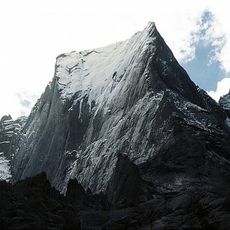
Piz Cengalo, Alpine summit in Val Bregaglia, Switzerland and Italy
Piz Cengalo is a 3,369 m granite peak on the Swiss–Italian border, rising between Val Bregaglia and Val Masino. Its broad snowy summit dome sends out three ridges: the rounded south ridge with a marked fore-summit, the west ridge to Cengalo Pass (3,057 m) and the east ridge to Gemelli Pass (3,106 m). The north face is the highest and most complex, with massive pillars and steep gullies.
The first recorded ascent was made on 25 July 1866 by the British climbers Douglas Freshfield and Charles Comyns Tucker with the Chamonix guide François Dévouassoud, who climbed from the south along what is still the normal route. The north face was long unstable: a rockfall on 28 December 2011 brought down roughly 1.5 to 2 million cubic metres, and on 23 August 2017 about 4 million cubic metres broke from the north-east wall, the largest such collapse in Graubünden for decades. The resulting debris flow damaged Bondo and killed eight hikers.
The name derives from the Bregaglia dialect word chénghel, which denotes a wooded or grassy slope near rocky drops, a description of the mountain's lower flanks. The Italian form Pizzo Cengalo and the German Piz Cengalo are used on either side of the border. The summit ridge carries the state border, and the Gianetti, Sciora and Sasc Furä huts serve climbers on the Italian and Swiss sides.
The main access route is through Val Bregaglia, with Rifugio Gianetti serving as the primary base camp for climbs. Visitors should prepare for Alpine conditions and check weather and mountaineering conditions before attempting the ascent.
The Gaiser-Lehmann route on the northwest pillar, 1,100 m over 25 pitches at grade V+ to VI−, started from the Sasc-Furä hut. Since the rockfalls it is considered too dangerous and is practically no longer climbed. The Vial high trail across the north flank was buried in 2017.
The community of curious travelers
AroundUs brings together thousands of curated places, local tips, and hidden gems, enriched daily by 94,216 contributors worldwide.