Waldfriedhof Davos, Protected cemetery in Davos, Switzerland.
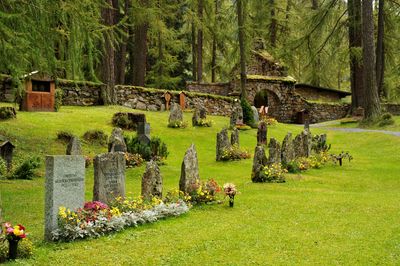
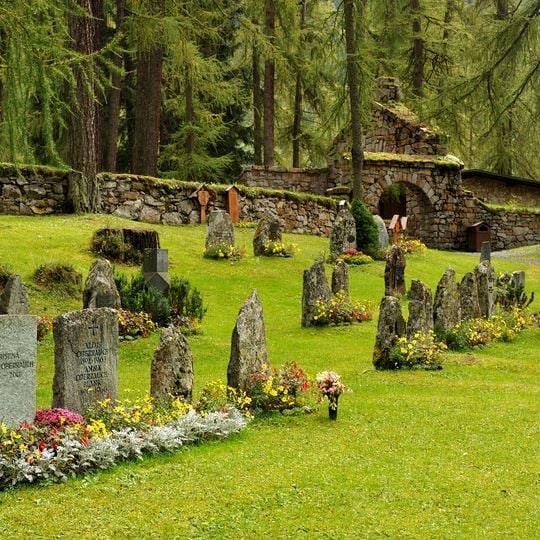
Waldfriedhof Davos, officially Waldfriedhof Wildboden, lies between Davos Platz and Davos Frauenkirch in an existing larch grove. Architect Rudolf Gaberel and Christian Issler built it in 1920; sculptor Erwin Friedrich Baumann designed the Cyclopean-masonry portal. Row graves form an elliptical layout, while private graves follow the natural uneven ground. Dry-stone walls enclose the grounds, and only simple larch-wood crosses and rough local stones mark the graves.
The Waldfriedhof Wildboden was built in 1920 by architect Rudolf Gaberel with Christian Issler; sculptor Erwin Friedrich Baumann designed the Cyclopean-masonry portal. After the Swiss Israelite Community Association had campaigned since the 1910s, a Jewish cemetery was added in 1930 and first used in October 1931 for the burial of a young man, Leos Krupkin. The site is listed as a class A Swiss cultural property of national significance.
The cemetery's rules allow only simple larch-wood crosses and rough local stones on the graves, a constraint that shaped its appearance. Many first-generation headstones were carved by the sculptor Wilhelm Schwerzmann. Private graves hold Ernst Ludwig Kirchner and his partner Erna Schilling, and Rudolf and Rosa Gaberel.
The cemetery is accessible via Wildboden street in Davos Frauenkirch, where clear pathways guide visitors through the grounds. Both paved and natural trails make it easy to walk through the burial grounds without difficulty.
The cemetery lies in an existing larch grove, and its dry-stone walls are unusual for German-speaking Graubünden. Since 1930 a Jewish section has stood within the grounds; its first burial, in October 1931, was the young man Leos Krupkin. The graves of painter Ernst Ludwig Kirchner and his partner Erna Schilling lie among the private plots.
The community of curious travelers
AroundUs brings together thousands of curated places, local tips, and hidden gems, enriched daily by 93,668 contributors worldwide.