Neumünsterkirche, Neoclassical church in Riesbach district, Switzerland
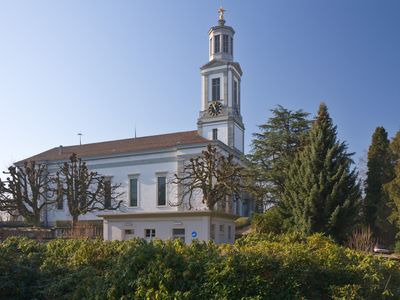
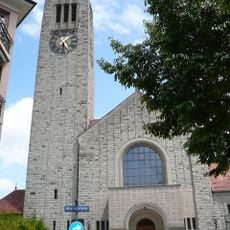
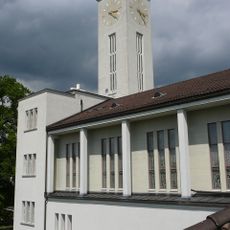
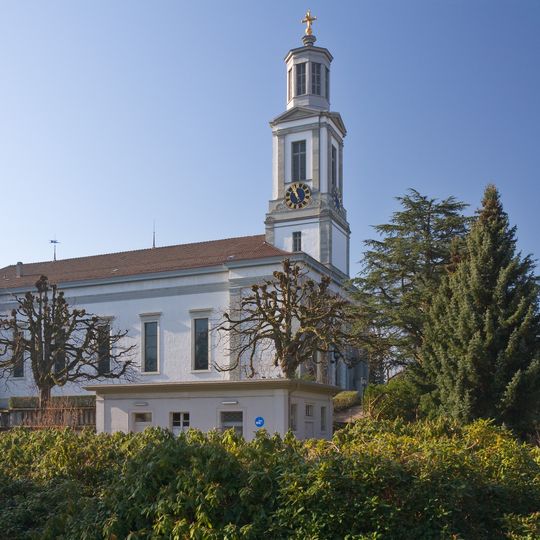
The Neumünsterkirche is a five-bay rectangular hall church on the Zelglihügel in Zurich's Riesbach district, built 1836–1839 to plans by Leonhard Zeugheer revised in a Neoclassical direction. Its late-Classical main facade has three portals framed by columns and pilasters, with the tower rising above the central one in three stages: a cube-shaped middle storey, a clock storey and an octagonal top.
In 1834 Reformed residents of Riesbach, Hottingen and Hirslanden obtained permission from Zurich's Grand Council for pastor Johann Jakob Füssli to found their own parish, since the walk to the Grossmünster was long. A joint-stock company financed the church, whose site on the flat Zelglihügel was chosen by vote. An open competition in August 1834 drew classicist and historicist architects; Leonhard Zeugheer won with a Neo-Gothic design but had to rework it in classicist form, built 1836–1839.
The name Neumünster ("new minster") was chosen in deliberate contrast to the Grossmünster, the old mother church whose long walk the Riesbach, Hottingen and Hirslanden residents wanted to avoid. Two paintings in the stairways to the tower gallery show the Transfiguration on Tabor (Konrad Zeller, 1839) and Jesus praying in Gethsemane (R. Münger, 1916).
The building is accessible via three separate staircases that lead to the main entrance area. Tram line 11 serves the nearby Hegibachplatz station, making public transport convenient for visitors.
The winning 1834 competition entry by Leonhard Zeugheer was Neo-Gothic, a style then seen as Catholic; to get it built he had to rework the plans in a Neoclassical sense. The front tower follows English Greek Revival models such as St Pancras New Church in London, and the design in turn influenced Felix Wilhelm Kubly's churches in Heiden and Wattwil.
The community of curious travelers
AroundUs brings together thousands of curated places, local tips, and hidden gems, enriched daily by 93,668 contributors worldwide.