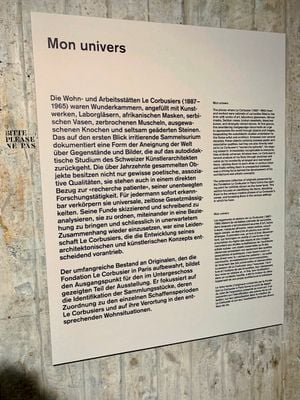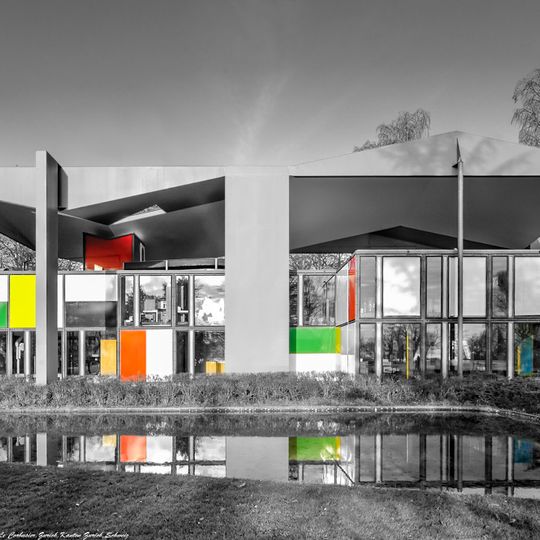
Pavillon Le Corbusier, Art museum in Seefeld district, Zürich, Switzerland.
Pavillon Le Corbusier is a glass and steel building near Lake Zurich supported by nine pillars that hold up its distinctive large metal roof. The structure creates an open interior space where the roof seems to float above the walls and supports.
Entrepreneur Heidi Weber commissioned the building in 1960 as a cultural center, with construction finishing in 1967 several years after the architect's death. Other professionals took over the project to complete it according to Weber's vision.
The museum hosts annual exhibitions featuring architectural designs and artistic works organized through the Museum für Gestaltung Zürich program. Visitors can experience how design principles shape both the displayed objects and the spaces where they are shown.
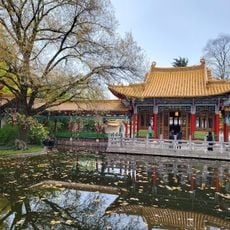
The pavilion is run by the Museum für Gestaltung Zürich and open only in the summer months, from May to November. It stands on the Höschgasse between the Riesbach harbour and the Zürichhorn, about a 20-minute walk from Bellevueplatz–Sechseläutenplatz. Trams 11 and 15 and bus 33 stop at Höschgasse or Fröhlichstrasse; bus 912 or 916 from Bellevue goes to Chinagarten, and ZSG boats also call at Zürichhorn.
The building follows the Modulor system with cubic elements measuring 226 centimeters on each side, based on the architect's proportional standards. This carefully planned measurement system runs throughout the construction and creates harmonious spatial proportions.
The community of curious travelers
AroundUs brings together thousands of curated places, local tips, and hidden gems, enriched daily by 94,514 contributors worldwide.