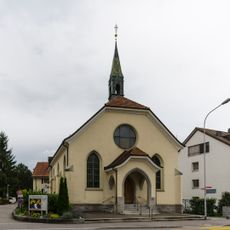
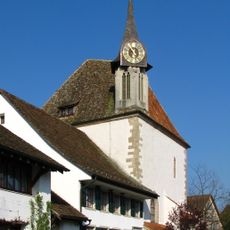
Reformed church, Neoclassical church building in Uster, Switzerland.
The Reformed Church of Uster is a transverse church in Classicist style, built 1823–1824 to plans by Johannes Volkart and modelled on the Reformed church of Wädenswil. A monumental staircase leads to a portico of four Tuscan columns; the 54-metre tower with pointed spire and scalloped gable was added in 1827. Inside, a U-shaped gallery surrounds a white marble baptismal font at the crossing of the aisles, with a two-storey pulpit of stucco marble by Heinrich Bräm (1838) on the tower wall.
A church is documented in Uster from 1099, when Bishop Gebhard of Konstanz consecrated it to the Holy Cross, the Virgin Mary and St. Andrew, with Count Heinrich of Rapperswil named as founder. The medieval Romanesque building stood for at least 725 years before it was demolished in 1823; the new church by architect Johannes Volkart was consecrated in October 1824 and completed with its tower in 1828. In 1444 the bodies of defenders of Greifensee, destroyed during the Old Zürich War, were buried at the church.
The church keeps the name of its predecessor, St. Andreas, and the medieval pastoral rights once tied to Uster Castle. Since 1991 it has hosted the annual Orgelfestival Uster under church musician Stefan Schättin, played on the 1963 Goll organ with 55 stops.
The church is centrally located and easily reached by public transportation, with bus routes serving the surrounding streets regularly. The pedestrian-friendly town center makes it simple to visit and explore the area around the building.
The four bells in the tower were cast in 1892 by the Keller foundry in Zürich-Unterstrass, not in 1882 as older accounts state. The tower itself, with its pointed spire and scrolled gable around the clock face, was only completed in 1828, four years after the church was consecrated.
The community of curious travelers
AroundUs brings together thousands of curated places, local tips, and hidden gems, enriched daily by 94,540 contributors worldwide.