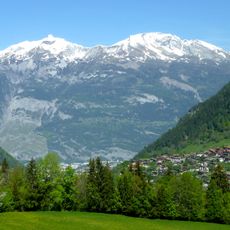
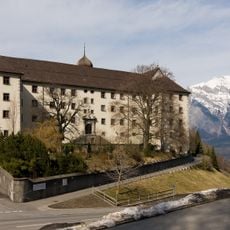
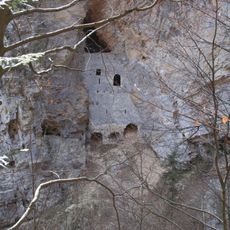
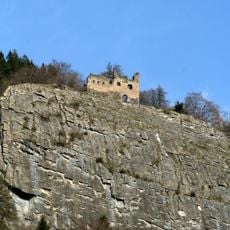
Drachenloch, Archaeological cave in canton St. Gallen, Switzerland.
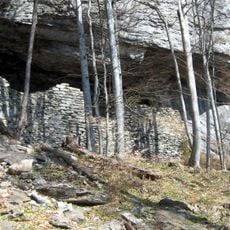
Drachenloch is a cave at 2427 m on the Drachenberg above Vättis, consisting of three straight chambers. The first hall is about 27 m long, 7 m high and up to 4 m wide; a 5 m narrowing leads to a nearly circular second hall about 5 m across, the driest part, used as living space. A 2 m passage opens into the rear chamber, about 17 m long with a low ceiling, ending in a lower room reached through a narrow crawl.
The Vättis teacher Theophil Nigg began excavating the cave on 7 July 1917 with his sons and a shepherd, finding a bear tooth and bones that he sent to Emil Bächler in St. Gallen. Between 1917 and 1923, 201 days of digging yielded 52 cave-bear skulls and evidence of Neanderthal occupation. A carved date of 1766 in the third chamber shows the cave was visited long before.
The name comes from an old local legend about a dragon that once lived in the cave. This tale has shaped how people in the region understand and connect with this place.
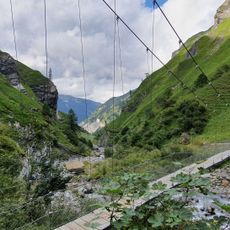
Two routes lead to the cave: a steep direct trail from Vättis via the Gelbberghütte, or a cable car covering the first 650 metres of ascent to Vättnerberg followed by roughly four hours on a faintly marked path across the Radeintobel. The five-metre entrance portal has a rope fixed on the left just before it.
The bone flute was identified by the researcher Brodar, who studied the cave-bear bone material in St. Gallen; it was made from the lower jaw of a cave bear. Experiments show it can produce a simple two-tone sequence. The cave also held two hearths and a sealed stone box of charcoal.
The community of curious travelers
AroundUs brings together thousands of curated places, local tips, and hidden gems, enriched daily by 93,991 contributors worldwide.