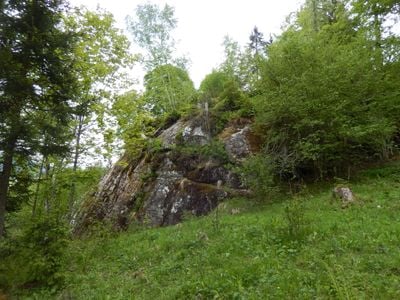
Luegibodenblock, Glacial erratic in Habkern, Bernese Oberland, Switzerland
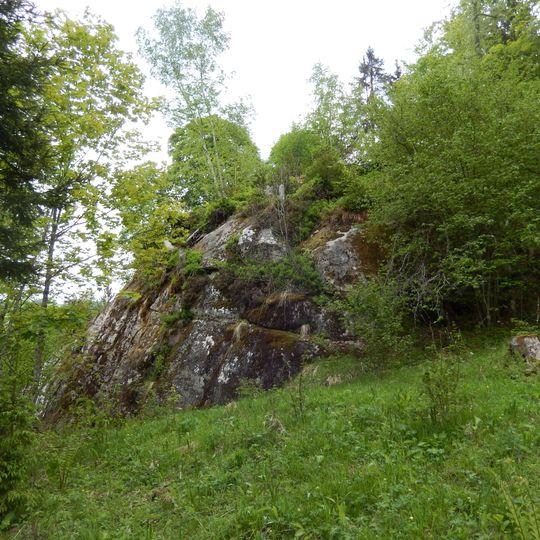
The Luegibodenblock is a granite block on a small plateau called Luegibode, one kilometre southeast of Habkern at 1100 metres on the southern slope of the Lombachtal. Its visible part is 14 metres high, 31 metres long and 28 metres wide; over half of its estimated 13,000 cubic metres lies in the moor and moraine. Mosses, lichens, grasses, bilberries and small rowan trees grow on its fissured surface.
In 1867 the Geneva geologist Alphonse Favre called for the protection of erratic boulders as witnesses of past glaciation. After an initiative by Bernhard Studer, Canton Bern resolved in 1868 to protect the boulders in state forests. That same year Friedrich Bürki, Isidor Bachmann and Edmund von Fellenberg bought the Luegibodenblock and gave it to the Natural History Museum Bern, which has owned it since 1869.
Habkerngranit was prized as an ornamental stone: its fine, hard texture and yellowish-red tone made it popular for house facades, and a gravestone of this granite long counted as a status symbol in the Bernese Oberland. Most of the many scattered blocks in Habkern were quarried away for this trade, leaving the Luegibodenblock as a survivor.
The stone sits about one kilometer southeast of Habkern village at roughly 1100 meters elevation. Marked walking trails through the Lombachtal valley lead to the location, which is best reached on foot.
The block's granite is unlike the surrounding Habkern flysch: it slid into a deep-sea trench as debris, was folded up with the Alps and freed again by erosion of the Lombach valley. Isidor Bachmann noted in 1870 that these "red granites of Habkern" are exotic rock, not true glacial erratics.
The community of curious travelers
AroundUs brings together thousands of curated places, local tips, and hidden gems, enriched daily by 94,028 contributors worldwide.