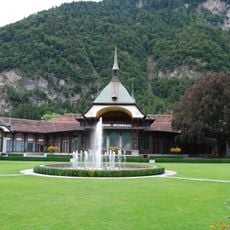
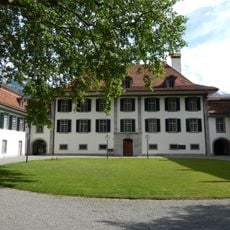
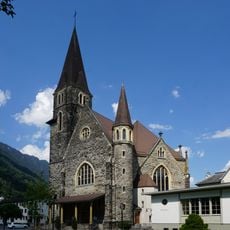
Japanese garden, Japanese garden near Interlaken Castle, Switzerland.
The Japanese garden in Interlaken is a compact designed space with water, stones, and plantings arranged according to traditional rules. The central water feature is surrounded by different areas with boulders, planted elements, and narrow paths that form a coherent composition.
The garden was built in 1995 as a gift from the Japanese city of Ōtsu to its partner city Interlaken, whose twinning dates from 1978. Ōtsu sent landscape architects and gardeners to work alongside Swiss specialists, and 380 tonnes of stone blocks were set in place following Japanese garden rules. It was the first public Japanese garden in Switzerland.
The name reflects Japanese landscaping principles, and the space shows how eastern design approaches work within an Alpine setting. Visitors can observe how stones and water are positioned to create a cultural bridge between two regions.
The garden sits between Hoheweg Boulevard and Schlosstrasse and is free to enter at any time of day or night. The space is fully accessible without steps, making it easy for visitors with strollers or mobility aids to move through it.
The garden used 380 tonnes of stone blocks, set according to Japanese garden rules. The Shinji pond stands for Lakes Brienz and Thun, and its islands show a crane and a turtle, symbols of long life in Japan. The number three recurs because the Japanese gardeners always planted trees and shrubs in groups of three.
The community of curious travelers
AroundUs brings together thousands of curated places, local tips, and hidden gems, enriched daily by 93,666 contributors worldwide.