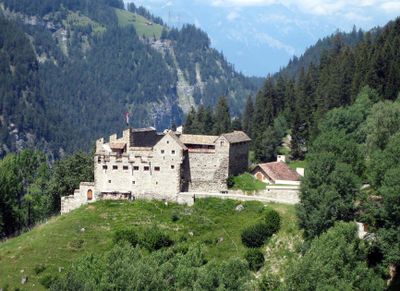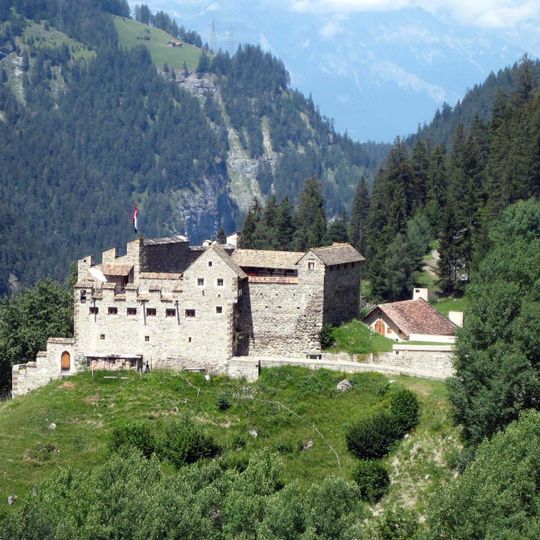
Burg Haselstein, Medieval castle ruins in Zillis-Reischen, Switzerland.
Burg Haselstein is a medieval castle that sits above the Hinterrhein river at about 1300 meters elevation in the Grisons region. Its remaining walls and structures clearly show how it once served as a fortified defensive position overlooking the valley.
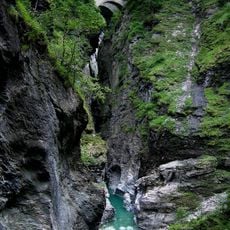
In spring 1273 Henricus de Rexene, a ministerialis of the Bishop of Chur, felled timber for a towerless castle above his village on the Hinterrhein, replacing a cramped tower beyond the Vidosschlucht gorge; tree-ring dating confirms the wood. The castle served for about a century as residence, small administrative centre and farmstead. In the first half of the 14th century the Waltensburger Meister painted frescoes in one room. After long rains the south palace's west front, built without foundations on moraine, collapsed around the end of the Trecento and the site was abandoned.
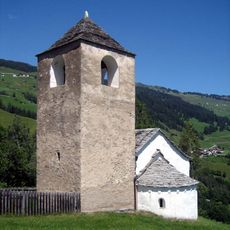
The castle's name comes from the Haselstauden and Espen (hazel bushes and aspens) that later covered its fallen walls. The Waltensburger Meister, working at St. Martin in Zillis in the first half of the 14th century, was a guest at Haselstein and painted a room with decorative frescoes; remnants were found 600 years later on plaster pieces in the rubble.
The castle ruins are accessible via marked hiking trails that wind through the mountainous landscape of the Grisons region. Sturdy footwear and good fitness are important since the path climbs steeply and the high elevation demands physical effort.
The castle walls are only 0.8 to 1.1 metres thick, thin for a fortress, and the west front of the south palace collapsed after long rain because it stood on moraine without foundations. Dendrochronology on timbers felled in spring 1273 dates the hurried construction.
The community of curious travelers
AroundUs brings together thousands of curated places, local tips, and hidden gems, enriched daily by 92,769 contributors worldwide.