Japoma Bridge, Railway bridge in Edéa, Cameroon.
The Japoma Bridge, formerly the Japoma Bridge, is a 160-metre steel truss arch bridge over the south-eastern arm of the Sanaga at Edéa. Completed in 1911, it is now used by pedestrians, cyclists and moped riders after road and rail bridges were built beside it. Four concrete figures by Pascale Marthine Tayou stand on its pylons.
Built in 1911 during the German colonial period as part of the Mittellandbahn from Douala via Edéa to Éséka, the single-track bridge was designed and manufactured by the Gutehoffnungshütte in Oberhausen, assembled once on trial in Germany, then shipped in pieces to Cameroon. Its 159.6 m span, longer than the Victoria Falls Bridge, was the largest in Africa at its opening. Work further inland was interrupted by the First World War.
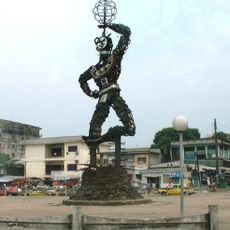
In 2011, for the Goethe-Institut's 50th anniversary in Cameroon, the 100-year-old bridge was declared a "cultural bridge" and a symbol of German-Cameroonian cultural exchange. As part of an art project led by Pascale Marthine Tayou, oversized concrete figures were placed on it, four of which stand on pylons at either end of the bridge.
The old railway bridge now carries pedestrians, cyclists and moped riders; road and rail traffic use the newer bridges built directly beside it. Its two river piers also support the old structure. The steel truss arch spans 159.6 m over the southern arm of the Sanaga, which can be up to 26 m deep during the annual flood.
The bridge's 159.6 m steel arch span was longer than that of the Victoria Falls Bridge (156.5 m) and was the largest in Africa when it opened. It was designed and built by the Gutehoffnungshütte works in Oberhausen, Germany, assembled once as a trial, then shipped in pieces to Cameroon.
The community of curious travelers
AroundUs brings together thousands of curated places, local tips, and hidden gems, enriched daily by 92,767 contributors worldwide.