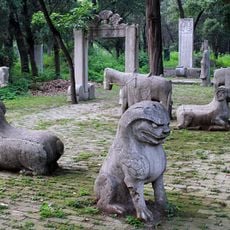
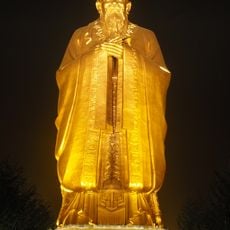
Yinqueshan Han Slips, Archaeological grave site in Linyi City, China
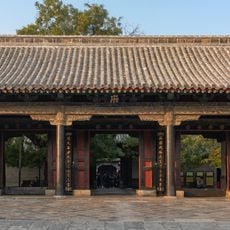
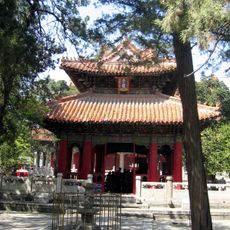
The Yinqueshan Han Slips are 4,942 bamboo strips with Western Han texts found in 1972 in two rock-cut tombs at Yinqueshan, a low hill southeast of Linyi. The tombs are rectangular vertical shafts, each with an outer coffin and an inner coffin, and a side compartment for grave goods. The museum, built on the site in 1981 and opened in 1989, is a classical palace-style building of about 10,000 square meters with 2,400 square meters of floor space, holding five halls: the tomb hall, Sunzi hall, Sun Bin hall, slip hall and artifact hall.
On 10 April 1972, construction workers at Yinqueshan southeast of Linyi reported a tomb; excavation revealed bamboo slips in Tombs no. 1 and 2, cut into the hillside with a rectangular shaft, one outer and one inner coffin each. Tomb no. 1 held 4,942 strips, Tomb no. 2 held 32 strips of a calendar for 134 BC. Burials date to about 140–118 BC.
The slips preserved the 16 chapters of Sun Bin's Art of War, lost for at least 1,400 years, alongside 13 fragment chapters of Sunzi's Art of War and the seven lost chapters of the Six Strategies, of which only the titles had survived. Their recovery settled the long debate over whether Sun Wu and Sun Bin were one person or two.
It works best to start at the tomb structures before moving to the bamboo strip exhibition. Allow extra time to read the text explanations and supporting materials, as the content is detailed and requires careful attention.
Researchers identified 80 different manuscripts among the discovered texts, with one tomb belonging to a military officer bearing the surname Sima. This personal connection helps visitors picture an actual person whose knowledge was preserved nearly 2,000 years ago.
The community of curious travelers
AroundUs brings together thousands of curated places, local tips, and hidden gems, enriched daily by 92,779 contributors worldwide.