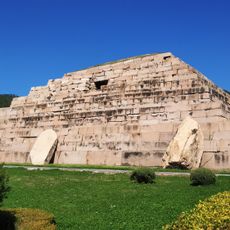
Chinese pyramids, Pyramidal tomb mounds in Shaanxi Province, China
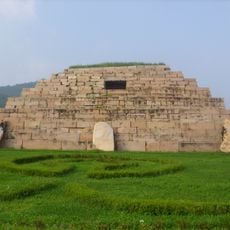
The Chinese pyramids are a group of about 38 pyramidal burial mounds and mausoleums for early Chinese emperors and their relatives, mostly on the Guanzhong Plains of Shaanxi Province, 25 to 35 km northwest of Xi'an. They are built of earth and mud rather than stone, and the largest, the Mausoleum of Qin Shi Huang at Lintong, measures 357 by 354 metres at its base and stands 47 metres high today, down from an original 76 metres.
The pyramidal tomb mounds were documented in large numbers around Xi'an in 1912 by the traders Fred Meyer Schroder and Oscar Mamen, and in 1913 by Victor Segalen's expedition. Segalen described the First Emperor's tomb and other Han-era mound tombs in his Mission archéologique en Chine (1914). After World War II, stories of a "Great White Pyramid" — the tomb of Emperor Wu of Han at Xingping — brought the mounds to popular attention, though Western scientists already knew of them before 1947.
The burial mound carries a name compared to the great pyramids of antiquity, though its shape and meaning belong to Chinese tradition. Visitors today see the grass-covered hill from outside and can tour the area with the soldier figures that belong to the same complex.
The burial chamber itself has never been opened, so visitors see the mound only from outside. The Terracotta Army pits lie about 1.7 km east of the mound and are covered by exhibition halls. The site is northeast of Xi'an in Lintong; allow time for the separate ticket queues at the mound and the pits.
Farmers digging a well in 1974 discovered the first clay figures a few kilometers from the mound. Each terracotta soldier has different facial features, as if they were modeled on real people.
The community of curious travelers
AroundUs brings together thousands of curated places, local tips, and hidden gems, enriched daily by 93,368 contributors worldwide.