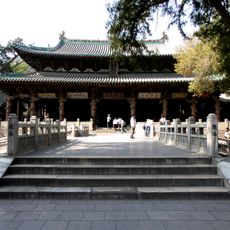
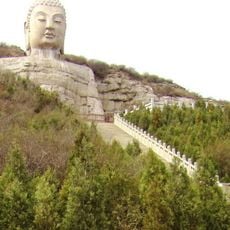
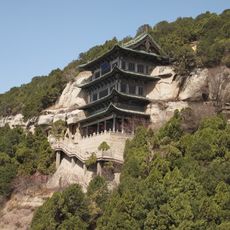
Longshan Grotto, Daoist cave complex in Taiyuan, China
Longshan Grotto is a Daoist cave complex on the summit of Longshan, about 20 km southwest of Taiyuan. It comprises eight caves, including Xuhuang, Sanqing, Woru, Xuanzhen, Sanda Fashi and Qizhen, with 66 stone statues of Daoist figures such as the Three Pure Ones and Wang Chongyang, plus eight relief dragons, a double-phoenix ceiling and crane carvings. The figures have plain, restrained drapery unlike Buddhist carvings.
The Daoist monk Song Defang (1183–1247), a patriarch of the Quanzhen school and disciple of Qiu Chuji, carved the grottoes in the early Mongol Yuan period, partly building on earlier work. Inscriptions on the cave walls date from the Mongol era. The site was listed as a national cultural monument in 1996 (4-192).
The site is Daoist, not Buddhist: its eight caves hold 66 stone statues of figures such as the Three Pure Ones and Wang Chongyang, plus eight relief dragons, a double-phoenix ceiling and crane carvings. The figures are plain and restrained, with simple clothing and clear folds, unlike Buddhist cave sculpture. The name Piyunzi, "Master of the Cloud Robe", belonged to its founder Song Defang.
Wear sturdy shoes since the site has uneven rock surfaces and steep stairs to navigate. The interiors are dimly lit, so a flashlight or your phone's light helps you see the carved details clearly.
The site is often confused with the Buddhist Tianlongshan Grottoes, 40 km southwest of Taiyuan, which hold over 1,500 statues in 24 caves. Longshan itself is Daoist: its 66 stone figures, eight relief dragons and double-phoenix caisson ceilings differ clearly from Buddhist carving styles.
The community of curious travelers
AroundUs brings together thousands of curated places, local tips, and hidden gems, enriched daily by 92,840 contributors worldwide.