Tianlongshan Grottoes, Buddhist archaeological site in Taiyuan, China.
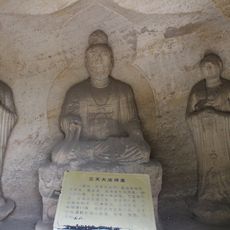
Tianlongshan Grottoes is a Buddhist archaeological site in Taiyuan, China, where caves were carved into two mountainsides. The caves contain over 1,500 stone statues and relief carvings spread across twenty-one separate chambers.
The caves were first cut between the late Northern Wei and Eastern Wei periods, and the earliest surviving chambers, caves 2 and 3, show slender figures with dense drapery. Under Northern Qi patronage from 550, when Emperor Wenxuan Gaoyang built a rock-cut temple, the sculpture grew rounder and heavier. Cave 8, dated by inscription to 584, is the largest Sui work, and most caves were carved from the reign of Wu Zetian to that of Xuanzong.
The Tang sculptures here gave their name to the "Tianlongshan style": full bodies, thin drapery clinging to the figure, and jewellery such as necklaces and armlets on the bodhisattvas. Cave 9, the Manshan Ge, holds a 7.5 m seated Maitreya above an 11-headed Guanyin of about 5.5 m, flanked by Manjushri on a lion and Samantabhadra on an elephant.
The site is easily reached by public transport from Taiyuan, as buses and taxis run regularly to the area. It helps to arrive in early morning hours so you can explore the caves with better light and fewer crowds.
In 2020 a stone Buddha head offered at a Japanese auction was matched by photo comparison and stone testing to the north wall niche of Cave 8, taken around 1924. It measures 44.5 cm and weighs 55.5 kg, with traces of pigment on the face. A Chinese collector bought it and donated it to the state; it arrived in Beijing in December 2020, the first Tianlongshan sculpture returned from Japan in nearly a century.
The community of curious travelers
AroundUs brings together thousands of curated places, local tips, and hidden gems, enriched daily by 94,089 contributors worldwide.