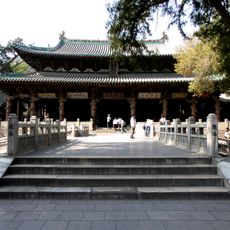
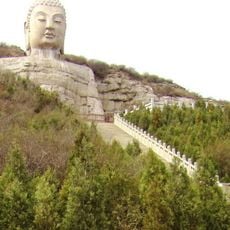
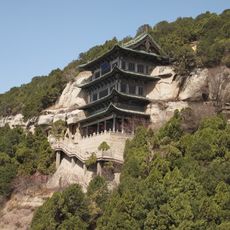
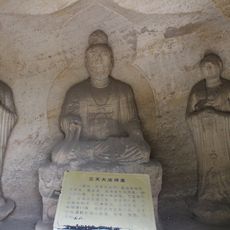
Chunyang Gong, Taoist temple in Shanxi, China.
Chunyang Gong is a Taoist temple on Qifeng Street in Taiyuan's Yingze District, dedicated to Lü Dongbin, whose Taoist name was Chunyangzi. It is the largest surviving Taoist temple in the city, covering 11,000 square metres and laid out in five successive courtyards running from south to north, combining temple and garden styles.
Chunyang Gong was founded in the early Yuan dynasty as a Taoist shrine to Lü Dongbin, whose Taoist name was Chunyangzi. In 1597, the 25th year of the Wanli reign, the Jin princes Zhu Xinyang and Zhu Bangzuo carried out a large-scale expansion. Further expansion followed under the Qianlong emperor of the Qing dynasty.
The temple is dedicated to Lü Dongbin, a Tang-dynasty figure honoured as Chunyang Zi, the 'Pure Yang Master', which gives the site its name; locals also call it Lü Zu Miao. The Ming-era Lü Zu Hall has a painted 'Eight Immortals Crossing the Sea' scene, and the fourth courtyard's Nine Palaces and Eight Trigrams compound is laid out according to bagua positions. The complex now houses the Shanxi Provincial Art Museum, which regularly mounts art exhibitions.
Chunyang Gong stands at No. 1 Qifeng Street in the Liuxiang subdistrict of Yingze District, at the northwest corner of Wuyi Square in the busy city centre. The temple is now the Shanxi Provincial Art Museum and holds art exhibitions, so some halls may be closed to visitors while displays are installed. Allow time to walk the five courtyards in sequence from south to north.
The temple's highest structure is the three-storey Xiaotiantai, reached through Lingbao Cave in the fifth courtyard. The fourth courtyard's Jiugong Bagua Yuan is laid out according to the eight trigrams, entered through the Xuwu Cave whose plaques read "Bie You Dong Tian" and "Yingzhou Miao Jing".
The community of curious travelers
AroundUs brings together thousands of curated places, local tips, and hidden gems, enriched daily by 93,622 contributors worldwide.