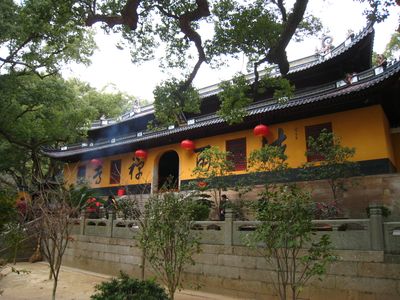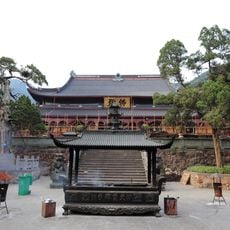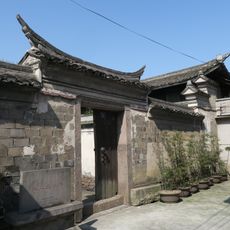
Fayu Temple, Buddhist temple on Mount Putuo, Zhejiang, China.
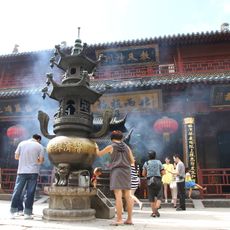
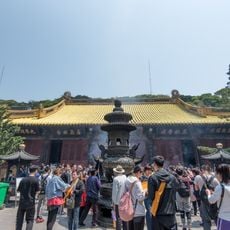
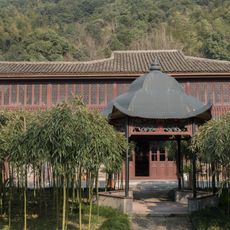
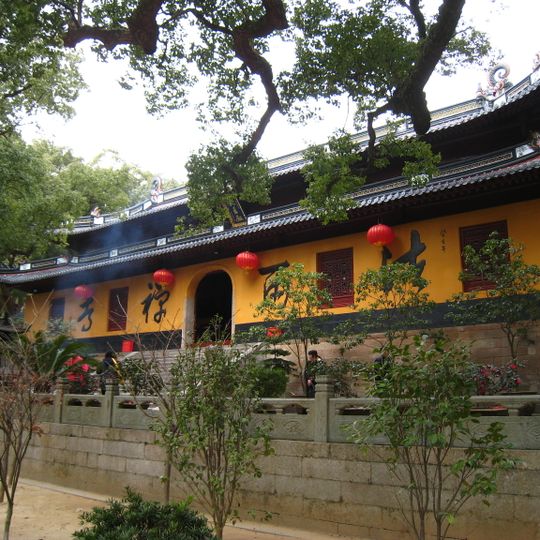
Fayu Temple is a Buddhist sanctuary on Mount Putuo with over 290 halls and rooms arranged in traditional Chinese architectural style. The buildings are distributed across expansive grounds with characteristic roof designs and symmetrical courtyards.
A monk from Macheng, Dazhi Zhenrong, founded a small sanctuary called Ocean Tide in 1580. Renamed Ocean Tide Temple in 1594, it burned in 1598, was rebuilt in 1605, and received an imperial plaque the next year. After refurbishment in 1687, Kangxi's 1699 plaque "Heavenly Flowers Dharma Rain" gave the temple its current name; Yongzheng ordered a major renovation in 1731.
The Hall of Guanyin, also called Nine Dragon Hall, holds a nine-dragon wall of bluestone carved in relief with dragons, brought from the nine-dragon palace in Beijing's Forbidden City during the Ming dynasty. The hall is counted among Mount Putuo's three treasures, with a Guanyin statue at its centre and the Eighteen Arhats along both sides.
The grounds offer several areas to explore, from meditation rooms to prayer halls spread across different levels of the mountain. Wear comfortable shoes and prepare for varying elevations and steep pathways.
The front door stands not on the central axis but at the southeast corner, a double-eaved square pavilion unlike the entrances of most Buddhist temples. Its plaque reads "Heavenly Flowers Colorful Rain" in gold on a blue ground. Inside, a 12-metre-wide Nine-Dragon Wall of pale stone replaced a brick three-dragon wall pulled down during the Cultural Revolution; the new wall was erected in 1987.
The community of curious travelers
AroundUs brings together thousands of curated places, local tips, and hidden gems, enriched daily by 95,160 contributors worldwide.