Tiantong Temple, Buddhist temple in Yinzhou District, Ningbo, China
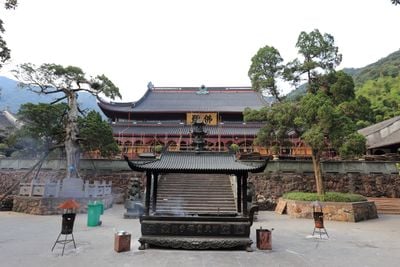
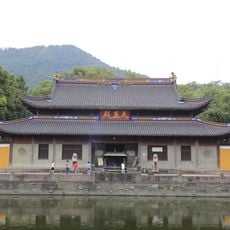
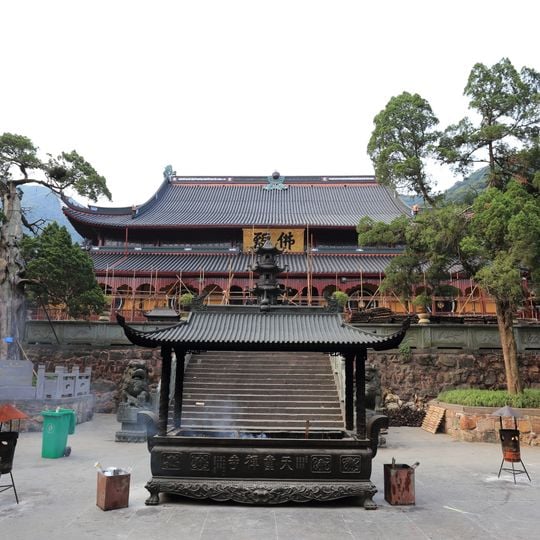
Tiantong Temple stands in a valley on the south slope of Taibai Mountain, 30 km from Ningbo. Its 30-odd buildings rise northward along a central axis: the outer and inner WANGONG ponds, the Seven Buddha Pagoda, a screen wall, the Heavenly King Hall, the Buddha Hall (the oldest, built in 1631), the Dharma Hall and the Arhat Hall. Covered corridors link the halls, a layout rare among surviving Chinese temples.
A wandering monk, Yixing, is said to have founded the temple in 300 CE at a site in the East Valley of Taibai Mountain. In 757 it was moved to its present location, and in 1007 Emperor Zhenzong of Song bestowed the name Tiantong Jingde Chan Temple. After a flood destroyed it in 1587, reconstruction under Miyun from 1631 to 1640 established the layout that survives today.
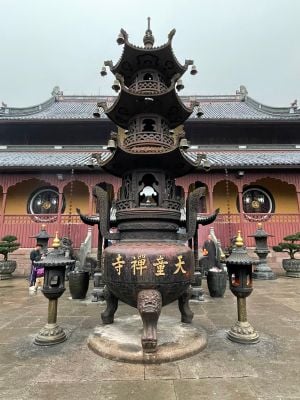
The name comes from a legend that the god Taibai sent a boy (tongzi) to carry firewood and water for the founding monk Yixing. The temple is the ancestral home of Japanese Soto Zen: the monk Dogen trained here under Rujing in 1225-1227, and a stele commemorating his stay was erected in 1998. The refectory's bronze "thousand-monk pot", cast in 1641, is 2.36 m across and weighs about 2 tonnes.
The temple is east of Ningbo and is surrounded by forest paths that run between buildings at different heights. The terrain is hilly, so comfortable shoes are a good idea, and visitors should allow plenty of time to move between the various parts of the site.
The temple's bell tower holds a bronze bell cast in 1934, weighing 7.5 tons and standing 2.76 meters tall. Its surface is covered with the Diamond Sutra, the Heart Sutra, the Great Compassion Mantra and the Rebirth Mantra. The temple also keeps a "thousand-monk pot" cast in 1641, 2.36 meters across and about 2 tons in weight, once used to cook two shi of grain.
The community of curious travelers
AroundUs brings together thousands of curated places, local tips, and hidden gems, enriched daily by 93,635 contributors worldwide.