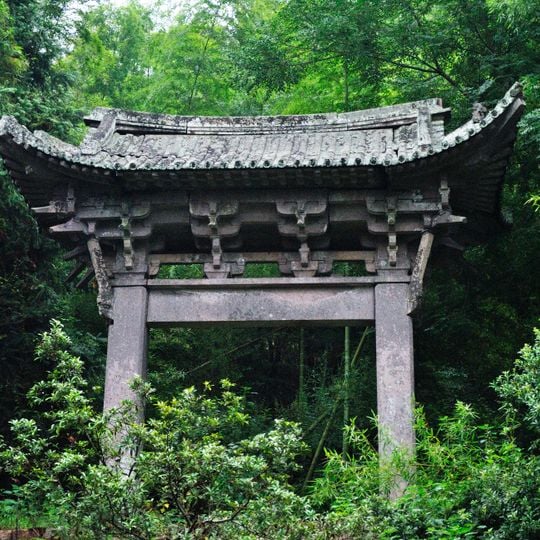
庙沟后石牌坊, Ancient stone paifang in Zhejiang, China
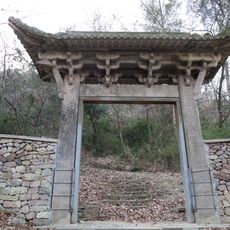
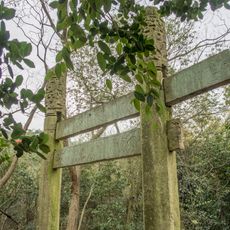
The Miaogouhou Stone Archway is a two-pillar, single-bay stone gateway 3.29 m wide and 6.16 m high, built of Meiyuan stone from western Yin County. It imitates a timber structure: a single-eave hip roof with bargeboards and ruyi-shaped hanging fish, tile rows with beast-face tile ends, and bracket sets beneath the eaves. The square pillars, 44 cm on each side, taper at the base and are set directly into the earth without plinths.
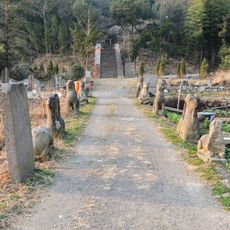
The archway was long dated to the Ming Jiajing era, but its form matches Song-Yuan timber prototypes and the 营造法式; since 2001 it has been protected as Song-Yuan, one of China's earliest stone archways. It stands on a tomb path at the foot of Bat Mountain, facing west, with no inscription or record naming its builder or tomb occupant.
The archway carries no inscriptions at all, and no historical text records it, so neither its exact date nor the identity of the tomb's occupant can be established. Its name links it to the village of Hanling, where it stands on the slope called Miaogouhou. Local memory instead attaches it to the Song-Yuan tomb landscape around Dongqian Lake.
The archway is best viewed in early morning hours when sunlight brings out the details in the stone carvings. Wearing comfortable walking shoes is recommended, as the surrounding area may have uneven terrain.
The archway's corner brackets use an upward-slanting strut instead of a lower arm, a southern Chinese form rarely surviving today. Its roof tiles are carved with toothed drip tiles, matching stone pagodas of the same era such as the Zhakou White Pagoda.
The community of curious travelers
AroundUs brings together thousands of curated places, local tips, and hidden gems, enriched daily by 94,405 contributors worldwide.