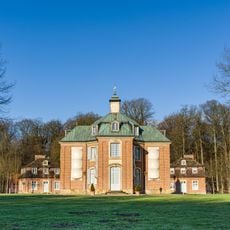
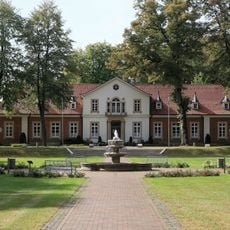
Clemenswerth Palace, Baroque hunting lodge in Sögel, Germany.
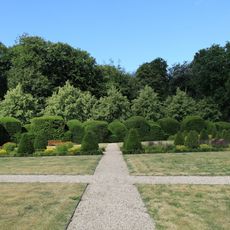
Clemenswerth is a hunting lodge with a central pavilion from which eight smaller buildings radiate outward in a star pattern. The complex is connected by straight pathways and landscaped gardens that reflect Baroque design principles.
Clemens August of Bavaria, Prince-Bishop of Münster, commissioned the lodge in 1737; Johann Conrad Schlaun designed it, and construction ran until 1747. The site lay at the northern edge of the prince-bishopric near Sögel. Materials came from far afield: sandstone from Baumberg and the Huckberg, roof tiles shipped from the Weser region via Emden, glass from Frankfurt, and Italian marble from Groningen. The chapel pavilion was added for the Capuchins, whom Clemens August called to Clemenswerth in 1741.
The museum displays collections of hunting equipment and porcelain from the 18th century, reflecting how important hunting was to the ruling class and how they spent leisure time with guests.
The grounds are best explored through guided tours, allowing you to see the central pavilion and surrounding buildings up close. Wearing comfortable shoes is recommended, as you will walk across the entire property.
The star-shaped ground plan may represent an eight-rayed sun, a nod to Clemens August's title of Electeur soleil. The main pavilion's windows align with the eight sight lines cut through the grounds, and chronograms in the window pediments encode the year 1737.
The community of curious travelers
AroundUs brings together thousands of curated places, local tips, and hidden gems, enriched daily by 93,856 contributors worldwide.