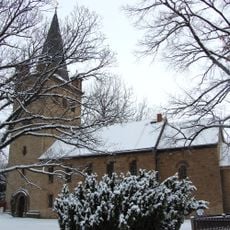
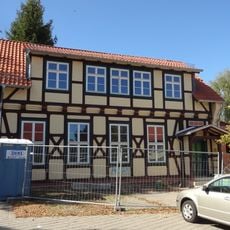
Ilsenburg House, Cultural heritage monument in Ilsenburg, Germany.
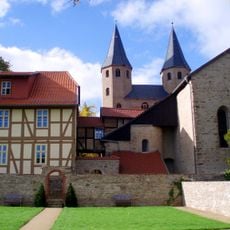
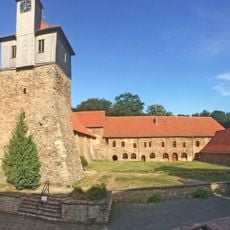
Ilsenburg House is a Neo-Romanesque building erected after 1860 on the west and north sides of the Romanesque Ilsenburg Abbey, above the Ilse river. It incorporates surviving medieval cloister buildings, and its present appearance dates from the second half of the 19th century.
The Benedictine abbey of Ilsenburg was dissolved in the 16th century and its estates passed to the counts of Stolberg, who had held guardianship since 1429. In 1648 Count Henry Ernest moved his court into a dowager residence built between 1609 and 1615 on the abbey's west side. Between 1861 and 1863 Count Otto of Stolberg-Wernigerode had the building above the Ilse extended as a residence for his uncle Botho, reviving the Romanesque style under architect Karl Frühling.
The house was the seat of the princes of Stolberg-Wernigerode until 1945. From 1897 it served as the dowager residence of Princess Anna and her daughter Elisabeth. The former abbey church, redesigned around 1700 under Count Ernest, holds a high altar, pulpit and baptismal angel carved in Baroque style.
The location sits on a hill above the river, requiring uphill walking to reach the building. The Ilsenburg Abbey Foundation manages the property and continues developing it as a cultural venue.
From 1930 the house trained theologians for service abroad at the Ecclesiastical Mission Seminary, dissolved in 1936 after it aligned with the Confessional Church. The same year a convalescent home for church workers opened in several rooms, joined two years later by an Evangelical Preaching Seminary.
The community of curious travelers
AroundUs brings together thousands of curated places, local tips, and hidden gems, enriched daily by 93,758 contributors worldwide.