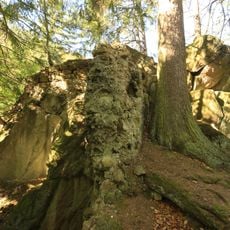
Ilsestein, Granite rock formation in Ilsenburg, Germany.
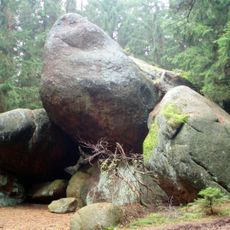
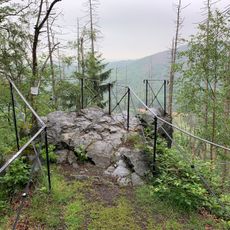
The Ilsestein is a granite rock formation rising to 473.2 m above sea level, about 2 km south-southwest of Ilsenburg. Its summit stands 130 to 150 m above the Ilse river, which flows past to the west. Excavations between 1955 and 1962 reconstructed the layout of a small Salian-period castle built on the rock in the 11th century.
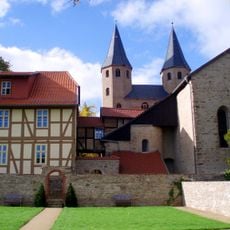
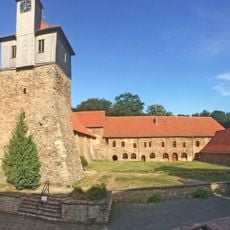
Around 1000 AD a small counter-castle was built on the Ilsestein, shortly after the Saxon fortress Elysynaburg became Ilsenburg Abbey under the Bishops of Halberstadt. Its garrison of imperial ministeriales raided the abbey's estates, and the castle was destroyed at the end of 1105 on the order of Pope Paschal II by an anti-imperial opposition. Excavations between 1955 and 1962 reconstructed its layout.
The name recalls the maid Ilse of local legend, whom Duke Henry is said to have been banished inside the rock for three years; Heinrich Pröhle collected the tales and Otto Roquette turned the best known into the verse epic "Herr Heinrich". Goethe names the Ilsenstein in the Walpurgisnacht of Faust I and, with the Heinrichshöhe and Schnarcherklippen, in Faust II; Heine describes climbing it in Die Harzreise, and Adelheid Wette's libretto for Humperdinck's Hansel and Gretel mentions an Ilsenstein.
The rock is reached by signed hiking trails that start from the center of Ilsenburg and follow the river valley upward. A guesthouse near the base offers food and rest, but the final stretch to the top crosses uneven rock so solid footwear is needed.
The iron cross on the summit was erected on 16 October 1814 by Count Anton of Stolberg-Wernigerode, one year after the Battle of Möckern, to commemorate friends who fell in the wars of 1813–1815. On 18 October 1913 a plaque explaining its origin was unveiled in the presence of Prince Christian Ernest of Stolberg-Wernigerode.
The community of curious travelers
AroundUs brings together thousands of curated places, local tips, and hidden gems, enriched daily by 94,561 contributors worldwide.